
Does the name Favero Electronics tell you? Probably not - I have not even knitted about my ears before. The first google result brings us into the joyful 90s, full of gifs and scrolling scrolls on the screen. I remembered my childhood ...

When the company spoke to me Velocity Workshop Workshop, offering for a while measuring the power in bero pedals signed by the Favero company logo I got a good look, hoping for a product like "bend it yourself", or "compose a device from our systems". Then, of course, it turned out that the pedals are completely another page and it looks like it's ok

Favero bePro is probably the cheapest power measurement on the market. PLN 2149 for measuring from one pedal or PLN 3199 for a full one is definitely less than the competition (although thanks to autumn promotions you can get Garmin for 4500 PLN / 3000 PLN or Stages from 2000 PLN). As a man who likes expensive toys that are relatively cheap, I can not pass by him indifferently.

At the beginning I would like to point out that I can not write to you: "yes, take these pedals, they are great". I do not take such responsibility on the chest. Let's be honest: my assessment can be based mainly on two aspects: quality of performance and accuracy of measurement, the rest is important, but completely secondary.
Quality
It's hard to judge the quality of anything done while doing about a thousand kilometers. Of course, I usually manage to ruin everything I get (or at least apparently damage it) quite quickly, but this time I have nothing interesting to say. Hundreds of relays and displacements, a falling bike, leaning against walls and other serious behaviors did not leave any permanent damage on the pedals. In tests of bloggers, who make tests definitely more decently than me:
DC Rainmaker - The Favero bePRO Power Meter In-Depth Review
the5krunner - Favero bePRO Power Meter Pedals - Detailed Review
we can read about plastic (housing), which is said to be very easily damaged - there are also not very encouraging photos. As DC Rainmaker has learned, it has only an aesthetic effect, because under a bad plastic is another, much more durable layer. There are no comments from me. The only pedal user I have found in Poland is not very happy with them:

However, we have a classic word against the word. I have not found other, typically negative reviews about this product on the internet. On one of my favorite forums weightweenies some people use them and after thousands of kilometers there are no problems (except that some shoes require a pad to not scratch the pedals).
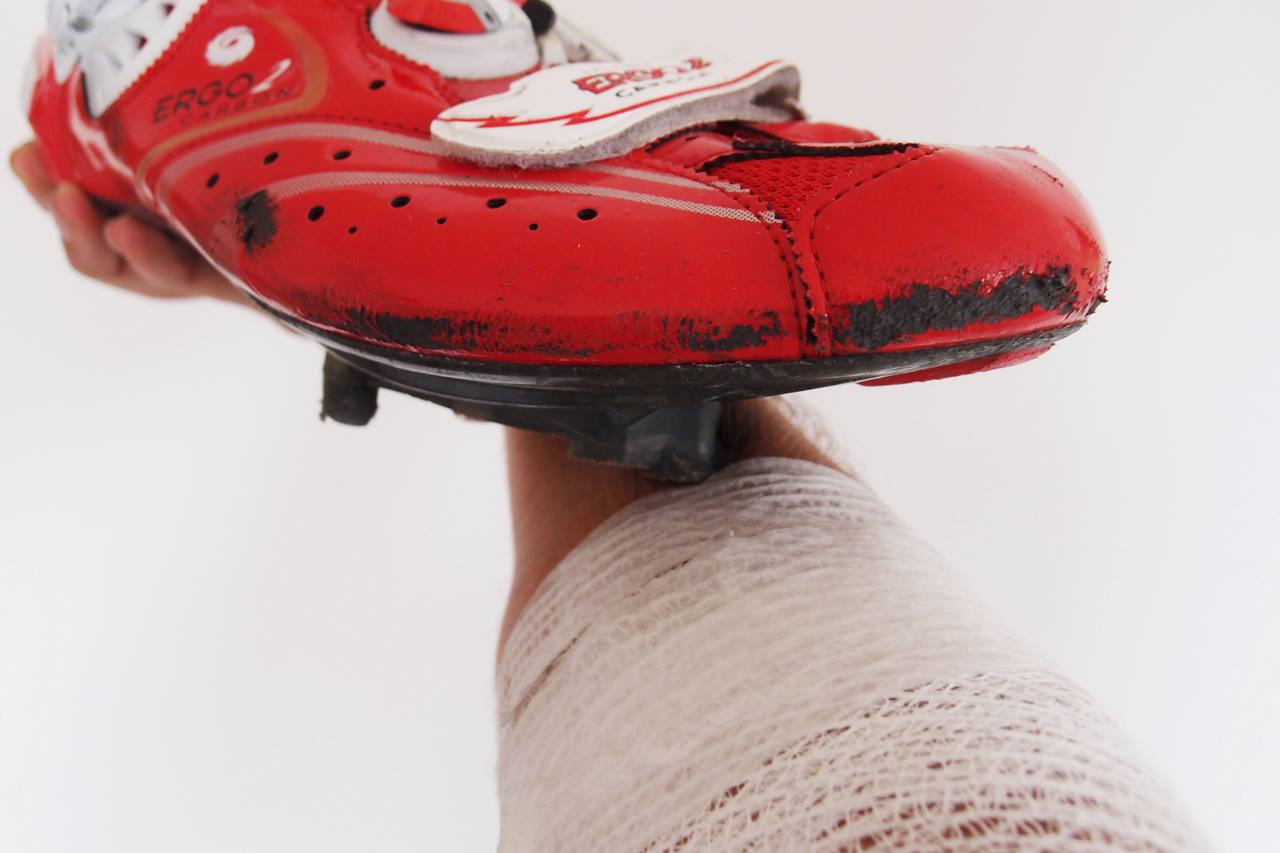
It can be discussed for a long time which type of meter is least susceptible to mechanical damage. It's hard to damage the hub in an accident, the crank can only be scratched - the pedals in this company are probably the worst. It is a consolation that, contrary to appearances at dump trucks, the whole impact usually takes over the shoe, which I experienced in my life more than once:
Accuracy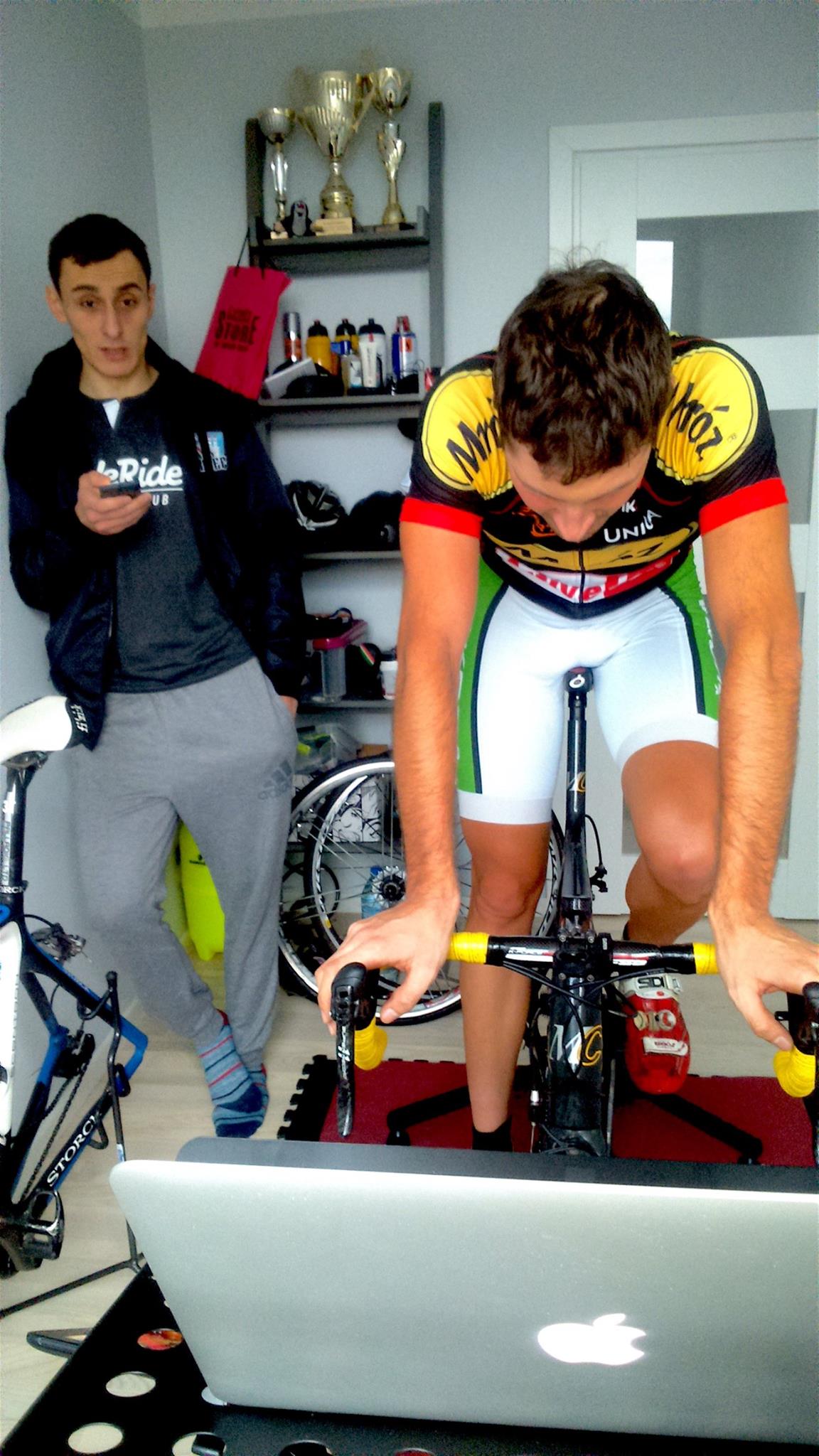
If something is good for millet, why would not it be enough for me? On the bePro run players from the group La Bardiani-CSF. Many times I have already learned that the first: professionals use what they get, not what they want, secondly: in sponsored equipment, it is not necessarily looking at the durability of solutions. Precision, however, must be at least very good.
Determining the precision of measurement is difficult, even with other devices on hand. I admire everyone who can do it properly. More than once we have tried to do this trick and never managed to do it as it should. Because how will I know which of the three systems used simultaneously shows well? Here again I refer to the tens of charts on the two above-mentioned blogs - it is clear from them that the error varies within the declared 2%. Also in my comparison with the Wahoo Kickr simulator, the values were similar. The delay is clearly visible, but this is normal in measuring this class. If you display current watts on Garmin instead of the average of 3 or 10 seconds (although I do not know why anyone would do it), it can be a bit annoying.
For me, however no measurement accuracy is important and repeatability. Accuracy is important if we use several measurements at the same time, we regularly research on their equipment, etc. For me, as an ordinary user, it is completely irrelevant whether my FTP threshold is 250 or 450W, provided that I can drive close to the values. With bePRO this is the case - I can go to 80% of FTP and I know that it is 80% of the threshold set on these pedals (or around 80% designated on the trainer).
Now that we know that pedals work, you can focus on the remaining issues:
compatibility
About 2 days after receiving the package from Poznań my Garmin died. I checked several configurations thanks to that, all of them worked practically seamlessly and intuitively.
- with Garmin 810
- with Garmin 520
- with Iphonem 5s, to which an adapter on ANT + was connected
- with Wahoo RFLKT + meter and iPhone. In this configuration, the meter converted the ANT + signal to Bluetooth and the adapter to the telephone was not needed.
The pedals are only intended for the Look system. For me it is a flaw, I prefer Shimano or Time (which I use on a daily basis). With Lookami I have a regular problem when I plug it in (it happens that trying to stick to the pedal in the opposite way, it locks at my shoe - I remember it painfully on Kinga's memorial). But this probably applies only to me - I have dozens of friends with this system and without any problems.
How it's working?
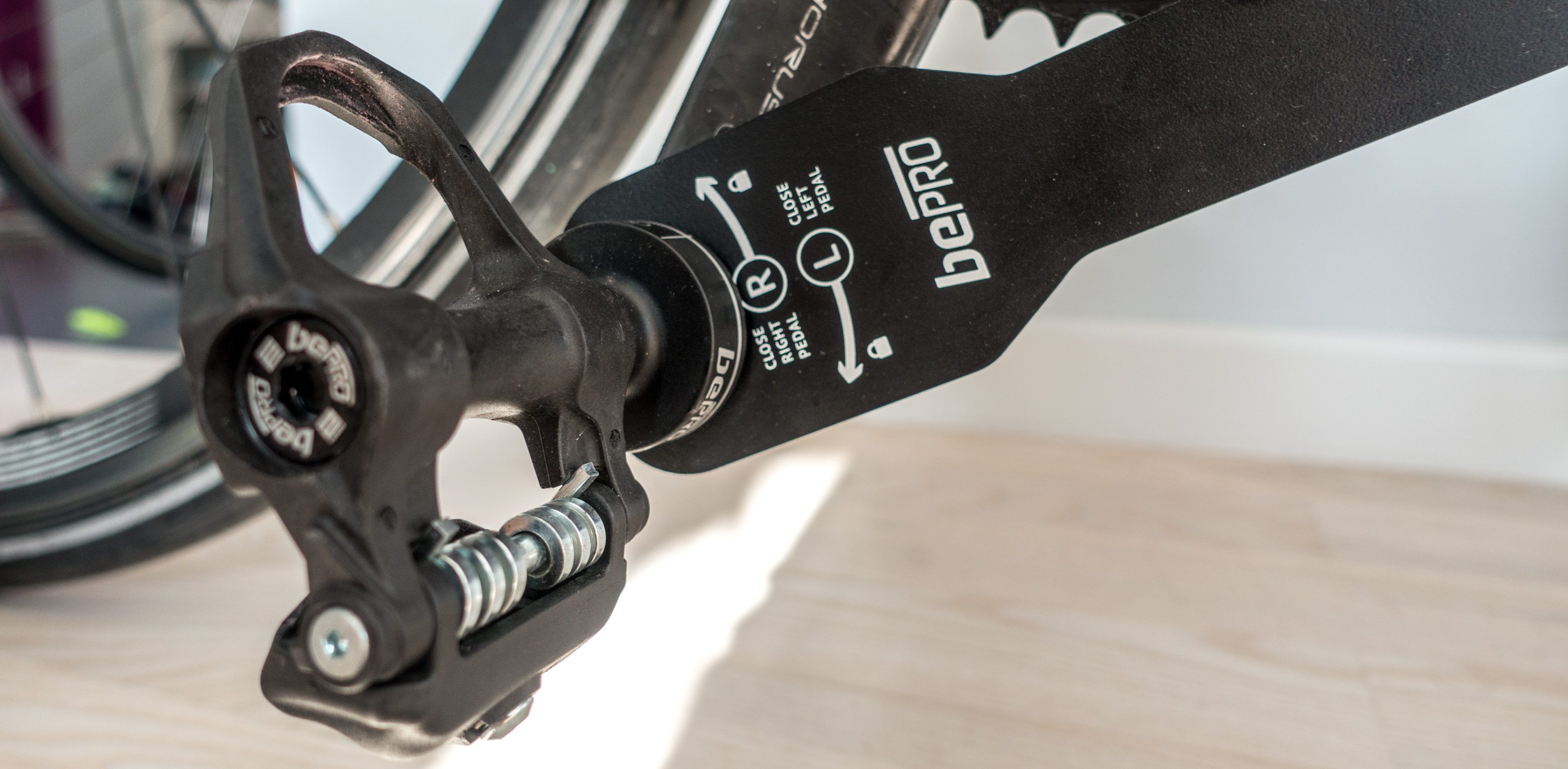
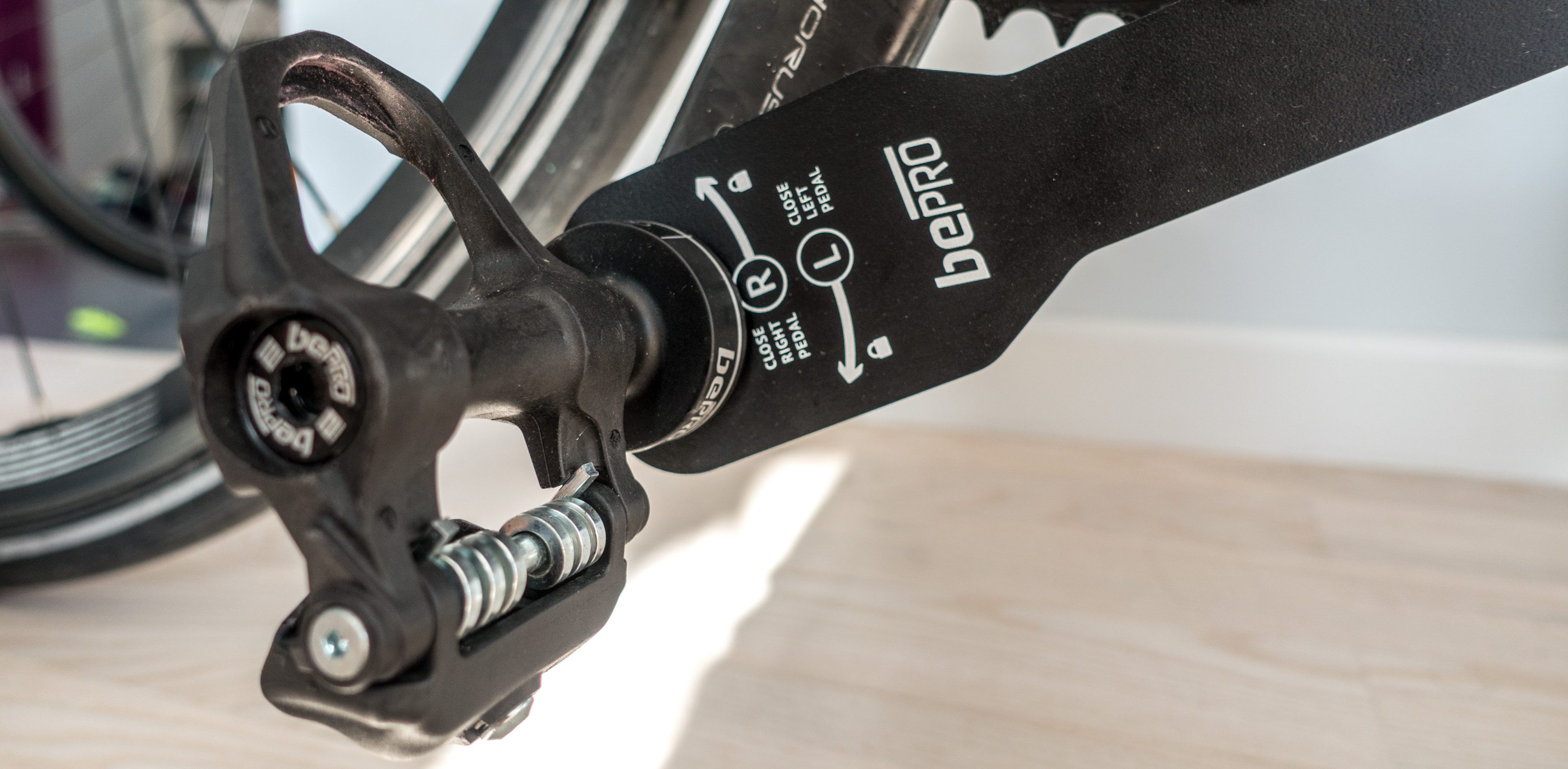
In my life, I try not to read the instructions, which usually ends in the way that the equipment starts to break as soon as I pull it out of the box. With the borrowed things, however, I do differently - I do not like to send away the damaged ... and good. The manual warns us that by turning the wrong things wrongly into the wrong direction we have a good chance of damage, which warranty does not cover. I recommend that you study these several small pages written in the style of IKEA. The whole operation should not take more than a few minutes (or a dozen or so if you're a little handcuffed manually like me). The process looks like this:
- Try to unscrew the old pedals
- Break three keys and make two hexagons
- Go to the site to get you the seared pedals removed. Promise yourself that in the winter you're doing a trembling
- Return home and think about why you were not on the site to tighten the new pedals. It's good that unlike Vectorów, you do not have to do it with accurate newton meters.
- Screw such metal sticks into the place where the pedals should be (carefully, because the sticks, although solid, have plastic threads)
- Install on the sticks such an aluminum square that will show you where to place a small sticker
- You take off your chopsticks. The sticker was needed only because it has a small line to which you will straighten the line on the pedal axis - so that it is even. Then you can unstick it and hide it, because there are only 4.
- The advanced system of two knobs and two keys tighten the pedal so that it is flush with the dash
- You see if everything blinks with lights as it should (there are several LEDs on the pedal, without instructions for China I do not know what combination corresponds to the message).
- You click on Garmin (or phone or what you use): calibrate
- Ready
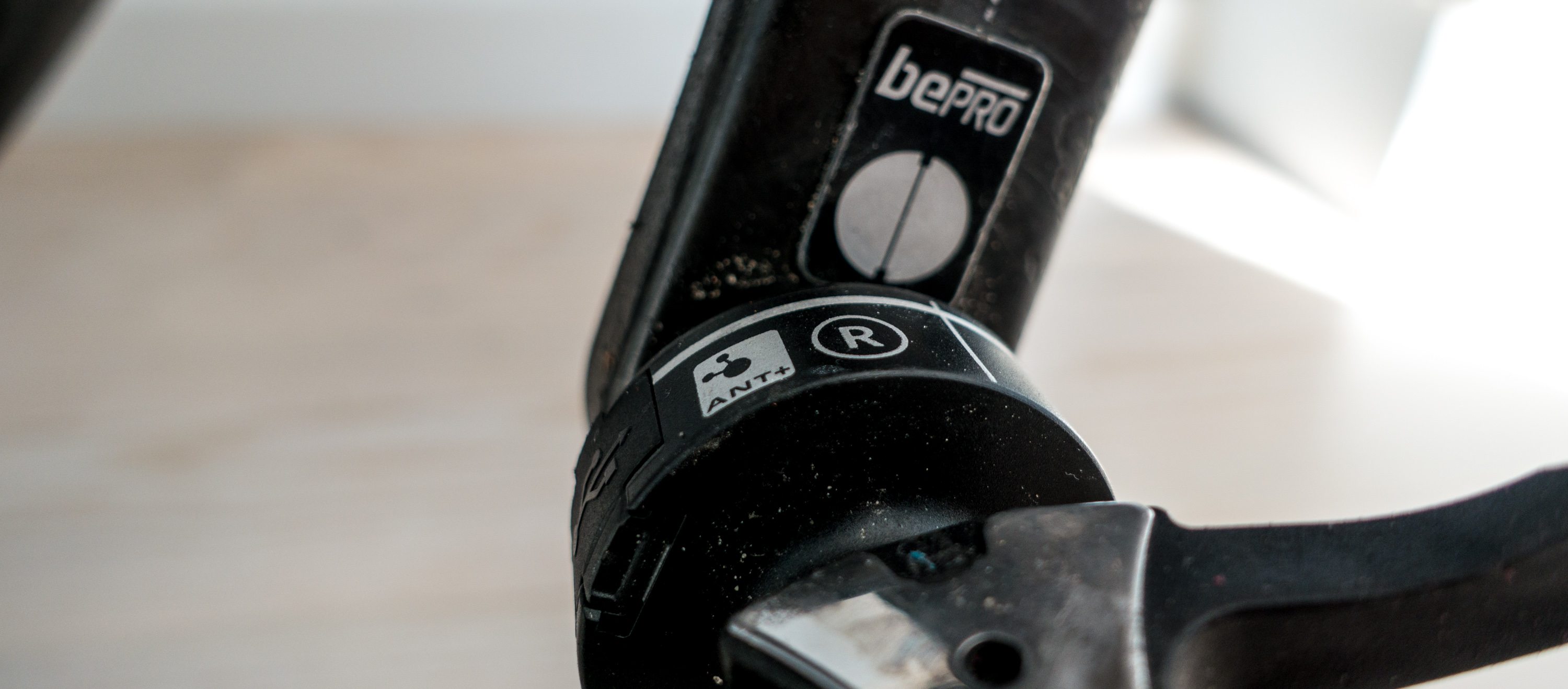
Several dozen or several hundred kilometers later, the pedals will probably turn slightly and recalibration will be required. This time, using a super-complicated procedure, turning the crank a dozen times back, and then driving for a while with constant power and cadence around 85 (measured with the help of pedals). Maintaining her is important, as I became convinced when, after the third unsuccessful attempt, I returned to the instructions. Then I never had a problem with it anymore.
When it comes to charging, the best possible solution is used - micro usb. Now the bike resting before the next ride looks completely abstract, when the cables connected to the current are hung on both sides.
Do I want this power?
It's so simple with a human being: you do not need to measure, then your colleagues have and you start to think about it, you rent a measurement, you start to like it, you can not imagine life without measurement, you look at the measurement less and less, you get rid of it, you miss it . Do you need it or it is necessary: no. Will it make you drive faster? Doubtful. Is it cool? Of course!
What's the power for me?
When it comes to driving in a group, the measurement is useful only to answer the question "was it hard today?". It's even funny when we can directly compare with each other two consecutive Ronda Babka and it turns out that in the first we rode much faster and we generated fewer watts. Weighted power from Ronda always comes out the same: 290W +/- 10W. You can, of course, count how long I can go with the given power in the escape and such, but in my case, in practice, it does not work out completely. It's like running away and looking behind you: you start to look = you start to lose.

Looking at the numbers, however, teaches one very important thing: managing your abilities. Looking for an analogy: driving with the meter is like watching the speed in the car, the heart rate monitor is watching the rotation, and watts is an additional control displaying the petrol status.
Observation of current watts makes us realize how pointless it is to make changes. The extra 30% of energy goes to nowhere and you learn to save your legs with each subsequent ride. What you save now will be useful later!
On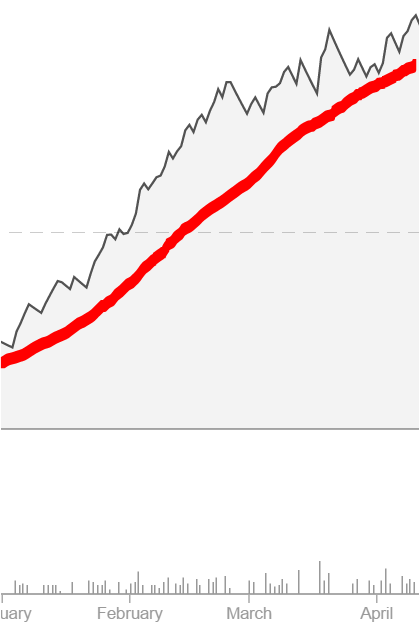 the more important in my opinion the profit from having a power measurement is the possibility of easily and precisely measuring the training load. Thanks to this, I know that going to the mountains for a week, I ride in them about 5 times too long ;-) This knowledge on vacation is useful for nothing, but I never had such a jump form as this winter, when I carefully planned short workouts and even more carefully I rested after them.
Besides, plus not watching the speed is such that we become windproof. Looking at the generated watts, it does not matter to me whether I'm going with the wind or wmordwind. Speed is irrelevant, it's how much I press the pedals - if it blows in the face, high values are easier to maintain (subjectively).
One pedal or two two?
If an additional thousand zlotys is not a heavy burden for us, it seems obvious that it is better to measure both legs than one. Personally, I do not know which option I would choose. If we do not have injuries or problems and disproportions in our bodies that have been troubling us for a long time, additional statistics seem to be an unnecessary luxury. For example, I regularly come out, that the left leg takes on a bit more work - it's probably the effect of youth, in which I used only her (handball) to jump. Will I do something about it? Probably not:

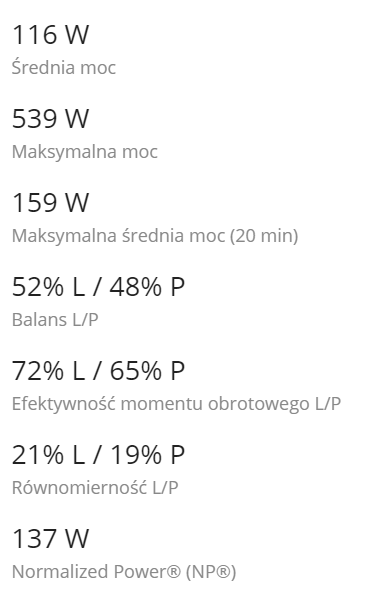 In addition to the balance, we get some additional info. However, remember that these data are not collected on Stravie!
Efficiency that tells us how much energy the other leg takes while pedaling (if it hinders the first one).
Uniformity, or how is the generation of power distributed over the entire crank rotation (or the same goes up and forward, which we push back and forth).
Here is a curiosity: the faster I go, the balance and the remaining variables are closer to the optimal ones. It's nice to work on driving technique and to detect irregularities, but after a few uses, I completely ignored these values. It turns out that the cost-optimal solution is to borrow a two-sided power measurement - verify the numbers and if everything is in the norm, buy a one-sided.
Summary, or tl; dr
Wow, you've read through to the end ... or you looked at the last paragraph straight away to read the summary. It is difficult to seriously assess the equipment that has been used for several dozen hours. The selection of measurements is becoming more and more important on the market, and thus - prices are falling. If you want to use it on more than one bike, pedals seem to be the best option. In a direct duel we have Vectory from Garmin and P1 from Powertap. Both of these companies are checked by the number of users by several orders - unfortunately, the higher price is behind this. About Favero BePro it's hard to write something bad after such a short time: the assembly is simple, the internet claims to be as trouble-free and accurate as the nearest competition, and a little cheaper. I did the work alone with the assembly and calibration, and most importantly - I could not break them. Based on my uncertain opinion and blog opinions, which I trust, I think you can take a chance (although this word is probably inappropriate - the product is long enough on the market, that a serious fackup would have been recommended for a long time). Unless the difference in price is not important to us - then we take more tested solutions.

