
We visited Morocco a year ago - there was even an entry about it: Morocco - is it cool? I do not know. In the middle of this post there was such a statement:
This is an entry about how we did everything very badly. About the fact that Panda will never return there again, and I count the days to gather the boys, gravele and go with the sleeping bag to the Atlas mountains. (It will never happen! - Panda note.)
And here is a surprise - 13 months later I go with my friends, gravels and sleeping bags to the Atlas Mountains. Panda stays at home.
Most important: How much does weekly bikepacking cost?
488 PLN: ticket for man
350zł : ticket for a bicycle
866zł (2130MAD) : 7 nights + food
or: 1704zł
and it can be a bit cheaper, of course.
We withdraw money with Revolut from an on-site ATM (2,500 dirhams for about PLN 1,000). Interesting fact: the ATM withdraws from the zloty account, not the Moroccan one - the loss is already good morning. When leaving Morocco, we exchange the remains in the exchange office - 4 of us get 35 euros, the fifth 45 euros. It seems that the lady in the exchange office makes the calculations slightly "on watch" - so that "roughly" agrees. I have an irresistible impression that everything is in the country by eye, especially when it comes to tourists' money.
10 things to know.
1. Morocco is two worlds.
Big cities like Marrakech, Agadir, Casablanca are pathology, muck, noise, chaos. Virtually everyone will try to cheat you or offer unwanted help, for which they will demand money later. Even when buying rolls in the store, the seller can completely spend 50 PLN on purpose. A nice lady selling pies on the street says that the price is 5MAD, but when the moment of payment comes, it turns out that it was the price of a bald pie, without extras. For more examples, I invite you to last year's entry.
The other world is villages and small towns where people are nice, kind and helpful. Everyone is waving, screaming, the prices are low, known and no one will fool you ... I think. There are situations in local shops, when the seller pays 900 for a few wafers, and when he sees our consternation and desire to escape, he changes the price to 50 dirhams. Initially, we thought it was a fat scam attempt, but the situation repeats several times. So either the Berbers have a separate currency that the internet doesn't write about, or they are very weak in cheating.
Is it if everyone is trying to press x20 on you?
this is already a scam
or just such a practice?
2. Atlas stores are like RUCH kiosks.
As for stores on the route - it's hard - even in larger cities. The shops look a bit like our traffic kiosks (without the press) and are carefully camouflaged. A bit like a typical shoemaker's factory in Prague. As for the assortment, it is very unobvious. Usually they are oranges, 20 types of wafers (which differ only in packaging), a bit of chemistry and with a bit of luck some ulepce Delicacies. Very often they don't even have water in them. Well, damn - if you earn practically nothing and live in the countryside, which nobody visits, why would you buy water in a plastic bottle? At the store there is usually a dustbin used to burn garbage.
Four riders are riding, they are riding
Four riders are riding, four are riding
You are the first to hunger
Hunger everywhere in your body
It brings you hunger that you don't want and which you will get anyway
3. Week on bread, water, olives and wafers.
This situation means that we are permanently hungry for a week. In "hotel restaurants" we get either classic tajine (that is some potatoes, carrots, cucumbers, peppers and a minimum amount of meat), which waits for a minimum of 90 minutes, or bread with jam, melted cheese or humus-olive paste. With any luck you can also get an omelette. However, everything is so small and so inaccessible that we spend the evenings scraping with the last piece of bread after the tajine plate to get some burning to taste. I don't know what the melted cheese is all about, but it is the most popular addition here.

Generally, when spending an average of about 10 hours a day with a bicycle, no food strategy works here. So we embrace the proven technique: "survive for another hour and then come up with something." We extrapolate it for the whole day, then for the week.
Tap water and streams did not kill us, but we also tried to use treatment tablets as a preventive measure. Although while driving we did not have a situation where we would be close to death due to dehydration (capacity of water bottles ~ 1.6l), be careful and do not go below the emergency supply of 0.5l of water and several hundred calories in a bag.
4. In hotels rather empty
We find some absolutely absurdly dead season. In none of our accommodations (except Marrakech) we will meet a person other than service ... and the service usually consists of one person. We fall everywhere without a reservation. This means that we have to wait a long time for everything. For any food (the guest must go to the store), hot water, lighting the fireplace, etc. In some rooms, the temperature drops below 10 ° C, so we sleep in an owl, in a sleeping bag and under blankets. Blankets are everywhere and save the situation.
5. On the roads, rather empty
On most of the sections we cover, we don't see more than a dozen cars a day. Bitumen is very good but also very bad, and most of it is rough and disappears altogether in towns and on sharper bends.
Tourist places are an exception. The crowd is quite big there. Bicycle and scooter lanes are marked out on the main roads around Marrakech. When it comes to drivers, I don't think it is more dangerous than ours.
6. Top20 things to see in Morocco.
If I were to advise someone on a trip to these areas, I would recommend doing it like this: enter in Google "top 20 places morocco", mark them on the map and avoid. Tourist places are crowded and pathology. It's easy to meet - for example, you drive through the mountains and suddenly guests with camels appear.
7. Like the Pope or Wałęsa.
Traveling by bike around Morocco is not an obvious tourist activity. Passing through most places in the Atlas, we feel as if we were the attraction of the day (or even a week). Everyone waves us, everyone greets, children run after us, shouting and cheering. The words "Bonjour" and "ça va ?!" we hear about 10 million times. In the villages we are like a pope passing by papamobile, in larger towns like Lech Walesa, from whom everyone wants to recover their 100 million.
I am reminded why I decided to go for a black bike:
Yellow Canyon picks up all its attention
leaving my unnoticed
Just stop for half a minute in any village to be immediately surrounded by a bunch of kids. On the wilderness it takes a bit longer, but they can appear out of nowhere. Children are also quite characteristic, because in most of them there is no sense that maybe something is not right. They can stand 14cm beside you ruthlessly and watch you fight the change of inner tube for 35 minutes. Then, of course, they'll ask for money for visual assistance.
Kids can sometimes joke around with full impetus, but they don't know that Strength comes with us. If you are wondering whether it is possible to make a fivefold toe loop, I answer: with the help of this hand it is.

If they were Polish children I would say that they are good pitchers (in such a positive context)
but they are not
so I guess it's not right to say that
Generally, in the Atlas Mountains we wave much more often than on Sunday noon on the road to Góra Kalwaria. Not only that, in many driveways there are so many children running (and screaming) that we feel like Froome on TdF. Sometimes it is depressing, because in the case of ramps it is enough that they go. And of course everyone, but everyone is wearing jackets and long pants - it's winter.
8. Average temperatures very good.
We visit Morocco at the end of February and the weather should be completely different. Total drought finds us - even cacti dry out enormously. Lokalsi they don't remember when it was raining for the last time, the green areas are rather grayish, and the slope that we plan to visit is closed. The temperatures on the meters fluctuate between 57 ° C when we are driving in the sun, in an asphalt pan, to zero around the mountains, in the morning.
9. It's worth having toilet paper with you.
Generally local guys they don't use such luxuries. It is a bit puzzling when you visit a toilet in the back of a pub, and there is no paper and only a bucket with a tap, and a washbasin without soap outside. Awareness of health and safety rules must be abandoned quickly. Everything is done here with bare hands. After a week we are professionals in this. Grimy with sweat and sand, we enter the stores and naduszamy more breads to judge which is the least hard.
10. It's nice ... and it's hard
The Atlas Mountains are spectacularly impressive, but the routes are rather hard. These landscapes are somewhat similar to Canary, but such "much more". The combination of weather, lack of food, steep slopes and poor accommodation make it not necessarily a good choice for bikepacking beginnings or for cyclists who like coffee on the promenade. And they have our storks, which often build nests on minarets, and this raises a very important question:
What if the storks are Muslims,
who just fly to colder countries for the summer,
how Poland
Equipment:
They crossed the route:
Romet Boreas with 37mm tires,
Rondo Rut Al with 40mm tires,
Canyon Inflite SL with 40mm tires,
Factor Vista with 35mm tires (but tubeless - as the only one without a defect).
Bags are a full cross-section - from Podsacs, through Topeak to Apidura, as well as their location, but the minimum set, i.e. under the saddle, under the heart and under the frame, accompanied everyone.
Conclusions: 35mm tubeless is enough for 95% route, the other 5% killed my back. I recommend taking 40mm and tubeless (because stones).
You have to accept the fact that in such a dry and dusty environment full of flying stones, your bike will come back in a much worse condition: visually and technically.
In my bags, among others:
two cycling sets (shorts + T-shirts), 3 pairs of socks (including one warm), cycling sweatshirt, down jacket, ultralight jacket, long civil pants, civil jersey, two sweats, powerbank, cables, a pair of bars, mass of patches, 2 inner tubes , multitool, spare hook, 2 pairs of long gloves, sleeves, legs, sleeping bag, inflated mat, bivy (such a sleeping bag instead of a tent), first aid kit, insulation tape, towel, hand sanitizer (and other places), bicycle fastener, water treatment tablets. The whole, along with the bicycle and empty water bottles: some 16kg.
Useless things:
The cycling jersey was not used even once. Mattress and bivas (camping cloth) also, but they were treated like a first aid kit - for a rainy day.
Things deserving of the prize:
Down jacket - it turned out to be a brilliant solution - it is much smaller and lighter than a sweatshirt, warmer, more pleasant and you can sleep comfortably in it when it is cold, and in a civilian you do not look like a fool. Whether it's Rapha or Forclaz from Decathlon. I'm joining the down cup to the obligatory bikepacking list.
Tubeless tires - because not one nieprzygody. I change the recommendation for tubeless from "noł goł" to "goł".
Abus helmetwho survived (though suffered) repeatedly meeting low frames - this is in my opinion the greatest danger of Morocco.
TriEye glasses - this is not oakley quality of vision, but man gets used to the rearview mirror very quickly. Especially when it's worth knowing that a truck is approaching you from the horizon.
Eroe shorts - I still think it's the best.
Hammerhead Karoo, because although it weighs as much as Garmin 1030 with glued 820, not a single day the battery has not fallen below 50%, and the maps are used super comfortably.
Destination Lycra, which we met along the way (so I confirm that it was there) described here all the logistics in the MTB version and partly sleeping under the cloud, here:
-> -> link died <- <-
Route:
Asphalt: 656 km
total: ~ 900 km / ~ 16000 m
lowest point: Marrakesh (around 460m asl)
the highest point: Tizi n'Ouano (approx. 2,910m asl)

It is hard for me to assess the facts, but it seems that the surfaces nieasfaltowe They accounted for some 20-30%, which is just right.
We look for nights in the dark, but we have marked on the maps where to expect them.
Potential Dangers
Dogs are totally fired on us. They are more afraid of us than we are of them. With a bit of bad luck you can probably find a shepherd's madman, but he will be far enough to be prepared (evacuated)
Among the people we didn't meet anyone who was rude to us (we once met kids with stones, but they gently aimed at the tires and rather for fun).
There is a good chance of tumors and concussion due to super low door frames and all kinds of doors in the rooms.
Roads have no barriers and the surface is often conducive to flying out of the bend. Especially on asphalt roads which lose this asphalt during a sharp turn
Apparently there are scorpions - the internet says you don't die, but it hurts a lot. For wild nights, check your shoes.
The chance of dehydration is high, but not enough to carry more than 2l of water with you. In the case of food, you must be able to live on wafers and oranges. In a gate situation, any lokals should save us, because they are nice people.
We had a lot of time in queue to think about how we would pass the unpacked bikes through the check-out-tunnel-to-transport-water. It seems that the customs officers did not come up with a good way either, and eventually we go sideways, without any control. With heavy bikes under the arm and cardboard boxes on the back.
Here is a curiosity for fans of books (and I know from Instagram that there are many) - urinals at Menara airport are in the bathrooms so high that with a height of nearly 190cm I had to pee in a horizontal line. How are the lower ones doing? I don't know ... in time we began to wonder if they were actually urinals.


We leave the cartons at a car rental approximately 1km from the airport (Jasami Car) in exchange for a box of marshmallow. The deal was already established by e-mail, although I am not sure if this form of payment has been agreed. I have the irresistible impression that when we receive them in a week, it turns out that in fact storage costs a cardboard box, but already spending 100 euros from the head. Anything is possible in Marrakech. We set off.


Along the way, we hook up to an ATM that cheats us on money (withdraws from the zloty instead of dirham account) and we are PLN 20 in the back. Then, a visit to the store preceded by a long conversation with security "where you can and where you can't" lean your bike. We lose the conversation and park in a nearby restaurant, where we decide to eat, as it turned out later, the last reasonable meal this week. Like Enzo Gorlomi, we order "spaghetti quattro formaggi", which in 95% was "spaghetti uno formaggi" ... which is a luxury among local pasta anyway. For reasons unknown to us, in every conversation we use all the Italian / Spanish words that we know assuming that since most Moroccans speak French, we will get along. After the fourth day, calling for accommodation we limit our words to "Helo! Hotel OK ?! Today ?! Chamber OK?„
Then we only have 90km of not very pleasant route, because you have to leave this pathology, and it takes two hours to the hills from Marrakech. I learn from Instagram that Piotrek from Destination Lycra is in the area and is just drinking tea in the town where we plan stay looking for accommodation. The matter makes it much easier for us, because he deals with a guest from tadżinowej booth that he will find us 4 beds, and Piotrek himself will move with the tent to the terrace.


A paragraph that explains why people don't come with us.


Day II
Zerkten - Ait Blal
https://www.strava.com/activities/3128660314
132.5km / 2756m
- that it is very warm in Morocco and water is very difficult. When stopping in the center of Demnate (bread with melted cheese), the thermometer shows 39ºC, which is 33ºC more than when we set off
- that our kilometer plan is not feasible if we plan to drive only during the day (because why visit at night if you can't see anything)
- that the hills are very steep
- that we are a huge attraction for all local children


We have perfect accommodation - it's probably a ski resort judging by skiing in the hallway. Such a large cottage, villa could be said for local standards. There are rooms, beds, a normal restroom, a huge living room with huge windows overlooking the mountains and high life in general. After 1.5 hours of waiting for the tajine and photographing our passports by nice gentlemen officials, we go to sleep in a small room with 4 beds. Called: Tizinoubadou.


It may not have been easy, but it is definitely worth the ride. For the first time we cross the 2000m altitude border and our eyes are showing real, large mountains. The downhill is excellent, both scenic and cycling.


Only, of course, this is not the case, because while the beginning of the exit is a cycling highway worthy of being placed in an Alpine resort, then it does not get quite good. In Zaouiat Ahansal, the asphalt ends and we begin over 40km of wandering around the stones. I would describe driving as not very comfortable.
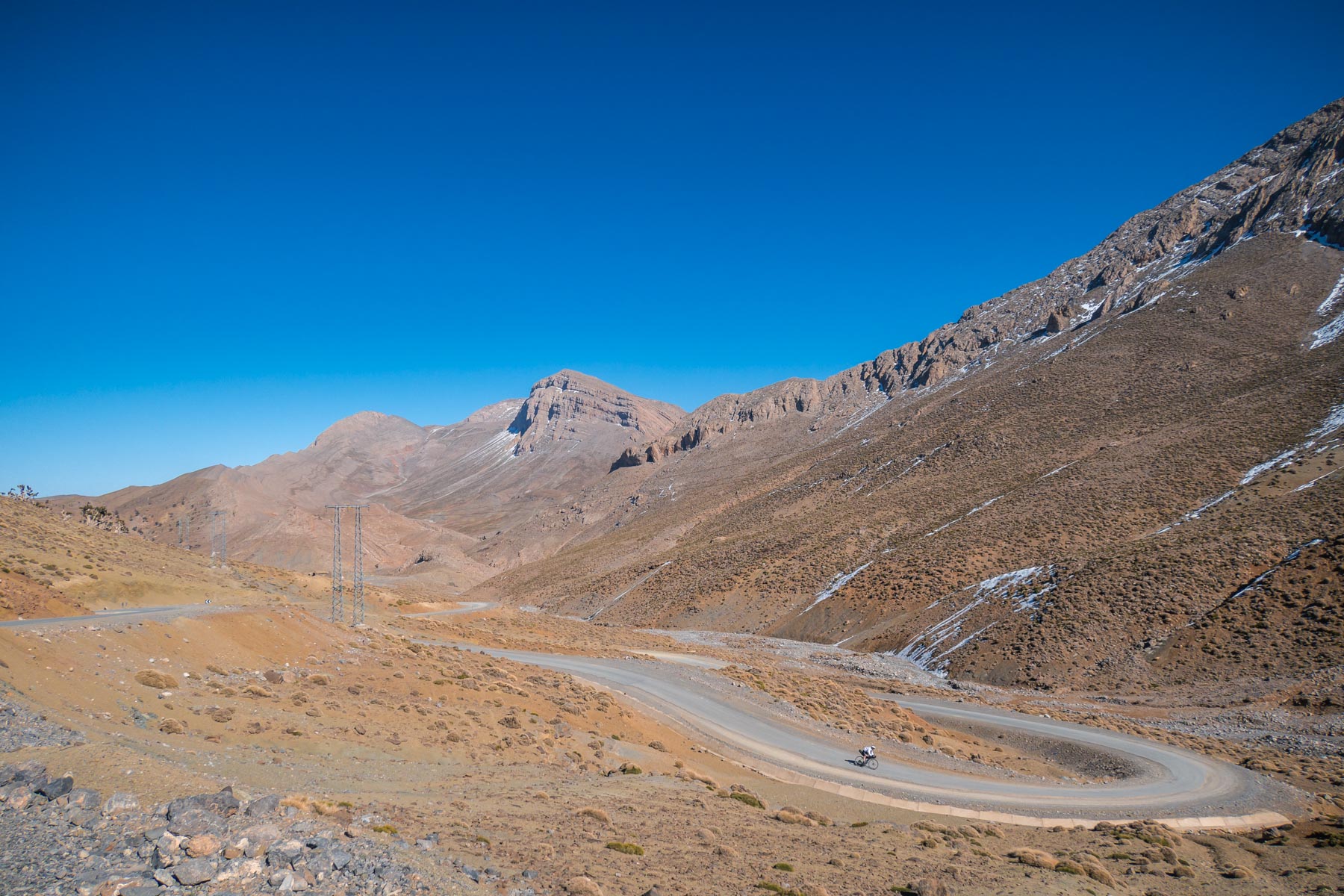


In the first of the potential accommodation there is no place - local guys they sleep on the floor alone and stuffing 4 smelly cyclists there is problematic. They only ask if we need water and suggest going a bit further - apparently there are accommodations serving rafting trips. In the current hydrological situation, such a trip would be rather a downhill ride. We get to Gîte La Cathedrale, where we are greeted by an empty hotel-restaurant. We get a tajine, the owner smokes in the fireplace and we start cycling discussions about whether this should be the vacation.


Wearing a bike by walking lightly on a slope full of stones may not sound particularly bad, but when the sun burns mercilessly and the skin on the right side of the body is clearly a different color than on the left (because on the 4th day in a row we go the same way), and the bike weighs 17kg, all sensations are multiplied.


We sleep in Espace Imilchil.


The driveway itself is not particularly tiring as we start it quite high, but it tends to be a bit mental, because the winding roads to the top can be seen from afar. When I think that a month earlier we were wondering if these roads would be passable at all, a smile of pity appears on my face. We expected snow here by the waist - at least this was what the people from the internet and their photos claimed. It's a shame. We had an alternative prepared for it - sideways, through Tinghir, goes the highest asphalt in the country. There is also a famous canyon Les gorges du todrawhich one on Google Street View looks at least impressive. However, we have no way to include this episode in our route. This is one of the few things that we would include in the trip if there was time ... or a way that allows a sensible loop there.


This is probably one of the worst downhill rides in my life. The plus is that it's better to go down than to go. The stones are too big.


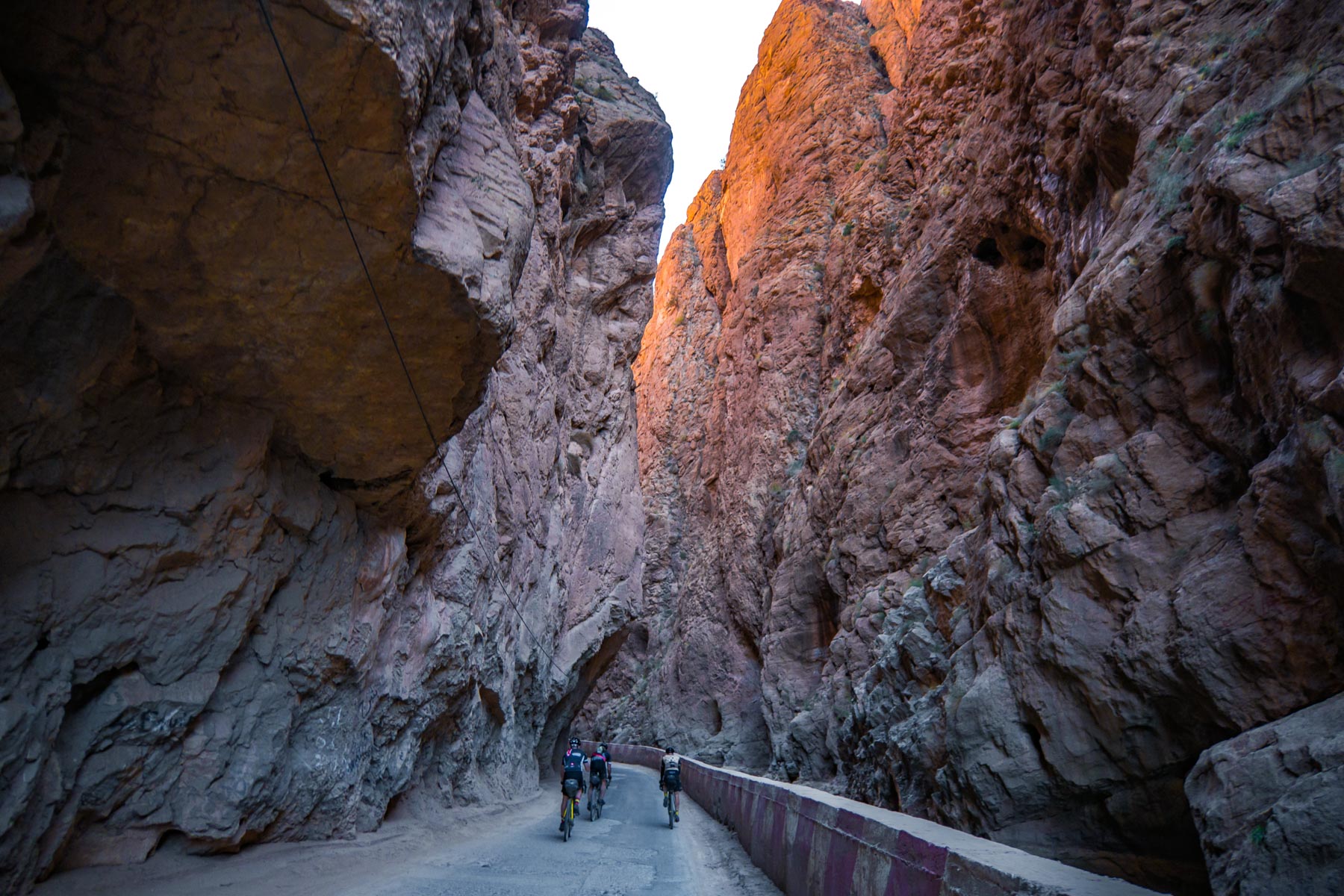


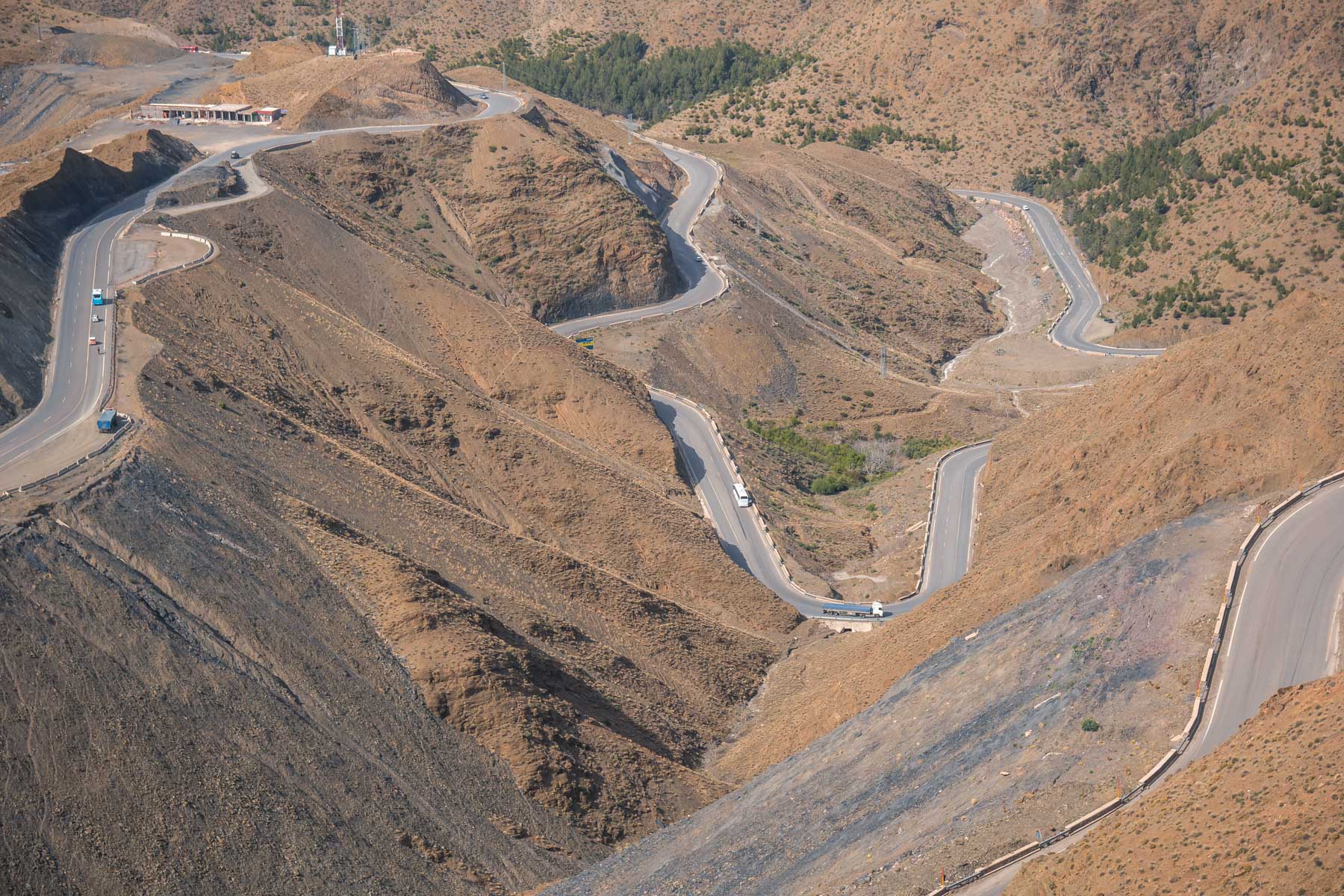


Day 7 no longer brings anything new - we are just following the circular route to Marrakech.
We have an emergency plan prepared for this day, for the ambitious - the Oukaïmeden ski resort, but if there is no snow, we skip it. In addition, Andrzej checked that it could not be closed in a meaningful loop and you would have to come back the same way. It is a pity this is the second highest asphalt in the country (2.650m), and the driveway itself is also impressive - from the side we drive it is 37km with an average of 5%, and then the exit to Marrakech: 70km with an average of 3%. Najsss.
Our route on this day is limited to a slightly longer and a bit tiring section grawelowej, visiting the crowded city of Ourika and climbing less than 1900m only to then go straight to Marrakech.


And I will not write about Marrakech anymore, because I try to keep the positive tone of this entry.
In any case, our boxes waited where we left them, and the plane, along with us and the equipment, returned happily to Warsaw.
Is it worth it?

