
If every time I heard that someone is not going to Rondo Babka, because he would get a penny from him, I would ride Cipollini now.
There is an incomprehensible fear in people about being beaten up. I will never understand it. During the first half of the year at Rondo a huge success for me was to keep to the dam in Dębe - for the uninitiated - it is some 15 kilometer route. Then it was getting better and better, and detachment from the peloton would be a good reason for jokes rather than a profession.
How to win Rondo Babka?
Winning a road race is easy ... at least comparing it with winning in any other sport. All you need is the right quotient of efficiency and happiness. Can you imagine that being an average person you win Run Warsaw or any other street race? Or you shave swimming competition, MTB, or triathlon? No matter how much the world tries to help you, you will not succeed. It is different in the road, theoretically there is a chance for everyone (* everyone at least average), you only need to find a race that takes place in Masovia or another flatland like a board (in the mountains watts are kilos and no self-preservation instinct - it's a different sport) and do one of the following:

- Take on solo, because no one is chasing such a madman. You start a solo hoping that the peloton does not want to go on a given day. Before they are overcome that it is a race and someone has to pull, you already eat ice cream at the finish line. Minimal success, but there were cases. Usually, even the winner is then surprised.
- You do the same, only to a few people. This situation happens much more frequently. You just have to hit the right place at the right time. Escapes are often, and it is not ProTour, the peloton does not always delete them - the lack of headphones in the ears can be salutary. It is often the case that when driving a training race with boys, we have a higher average than when racing.
- It is strange to find yourself at the right time in the right place during the finish. Here is required a lot of experience and familiarity with the group, because it is unlikely that we will succeed in the following trick (not for people with a motor in the frame)
- You can also be a strong leg with a strong leg and win it simply - being clearly the strongest. I would not count on it, however.

How to survive?
Okay, but the text was not supposed to be about winning. Once I have mastered this play enough to stand on the box more than once a season, I am very eager for such a temptation. For now - it does not seem to be promising. So: you're already on the road, you've gone on some group rides and you have not died, and most importantly: you did not kill anybody either. Wondering if it's time to check out in your first race. As a man who is average for quite a long time and despite the imperfect technique is still alive, I have a handful of advice on how not to get killed.
First primo ultimo: Road racing in the mountains is a completely different sport than racing flat, at least at the beginning. The first key will be to drive it over, rather than let anyone drive over. I will describe it in one of the next entries, for now, for example, we'll take a Mazovian classic like Rondo Babka, or any of the ŻTC.
Iron principles of the beginning beater
I assume that as a responsible person you have read all the guides on the Internet explaining how to drive in a group and checked it in practice. You were on your Sunday loop, both with groups that drive quickly and those that run uncoordinated - you have to be ready for anything. You know the label, formations, written and unwritten rules. I will not repeat this, because pages explaining how to do it are full. I will focus on more practical aspects, because:

AT THE BEGINNING AND YES YOU WILL BE BACK, unfortunately. The most important thing is to accept it. Regardless of how many guides you have read and how you abide by the rules, practice is governed by your rights. You can do stupid things, it's important not to cause danger. Everyone starts and the peloton will understand it. Do not push yourself forward and do not kill anyone, that's enough. That sometimes you hear some unflattering opinion (he, he, he - diplomatically said) about yourself, it's normal. Emotions often take on the top of the races, especially in terms of masters. Let it flow after you, but analyze your mistake.
BUY INSURANCE. Seriously. It is not about NNW or AC, that someone would pay you for losses. Accidents happen, everyone sometimes does something stupid and it's worth having OC. It's just fair to the people you drive with. It is worth looking for one that will also be valid during the race - soon. This will allow you to avoid unnecessary tensions between you and your friends, we live in the end when the average value of the bike at the race exceeds the average value of the majority of cars you pass by.
DO NOT PLAN. It does not make sense. It's easy to run: if I'm doing 10km, I know that I should stick to a minimum of 4min / km and keep my heart rate around 177bpm, if it's different, it means something is going wrong. In cycling, the opposite is true - you go the way others want. Well, unless you go to the very front - then others go like you. There are races that can be passed in a group without much fatigue, and there are those when you reach your maximum in the 5th minute. You have to grit your teeth and experience it - the pace will fall sooner or later (if you still drive your own max, it means that you still have a lot of training in front of you). Planning does not make sense, because you are going as the group travels, according to the principle that "in the peloton is resting". I always say to myself Rafał Majka, "if it is hard for me, it means that it is also for others". I consider myself a mediocre, which makes my calculations much easier - if I'm dying at the current pace, it means that at least half of the peloton also feels like that. You must think about what is "here and now" and not about whether you will have strength later. If you drive a piece behind the peloton then you have to go to the corpse to drive it up - in the final settlement it will certainly pay off.
RONDO BABKA THIS IS NOT A GOOD PLACE TO START. I started and I know there are a thousand better places. Go to any organized race. There are definitely fewer dangers lurking at every turn. Open car traffic is really uncomfortable with a side wind when wounded and fans are formed. There is also an ambulance that goes behind the peloton, there are professionals who can impose a pace that you will not encounter in a normal pursuit. In the event of a major accident, you are doomed to be detained by someone, which is why:

FIND YOUR KOLEGA. Cycling is a team sport or at least a group sport. Sooner or later, everyone will find out. The group is going faster and out of two in the middle of the race it is better to be in the 40th place, but in the pursuit group than on the 18th, but as a lonely one to ride off the first one. It is much more comfortable to travel with people you know. It is not even about the social aspect, but about the fact that there is a chance for a bit of kindness. Tight wounds, regrouping before the finish, erasing the escape in which you have found yourself, common verbal persuasion towards a person who does something stupid, lost water bottle, making changes - all those situations in which you prefer to have friends than enemies, which is why:
BE EGOISTIC, but without exaggeration. Unfortunately, cycling is a sport in which you sometimes have to be
bucem. Sometimes you have to not let someone in, sometimes somewhere to push with someone, there is no way out - being always polite lands in the back, because:
WHO DOES NOT LEAVE THIS GUB. The principle is very simple and it took me a while to understand this phenomenon. If you're going at a steady pace in a 100-person peloton, sooner or later you will notice that half of this group is somewhere in front of you on the horizon, and you have stayed with the other 50 people. If you do not overtake it means that you are ahead of you - if you are ahead of you it means that you are getting closer to the end of the group, and yet:
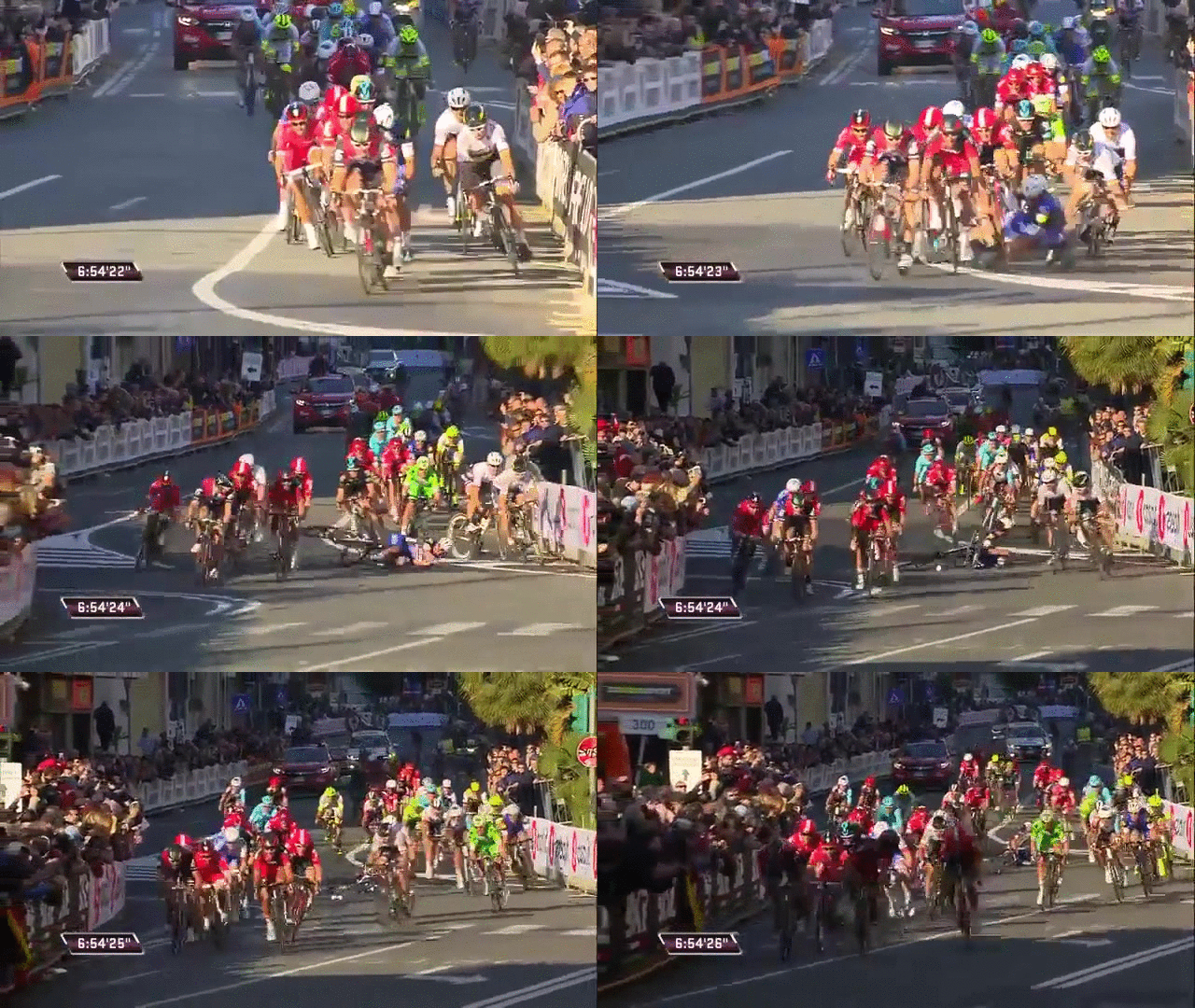
THE END OF THE GROUP IS DEATH. The back is harder, always. No one wants to be there when the racing begins seriously. The pace is torn, because any braking at the front or unnecessary release in the bend is a chain reaction backwards. The more people in front of you, the greater the chance that one of them will be in a minute or leave a bottle under your wheel. Skipping anything in the peloton does not always look like what Sagan presents:
DO NOT COMBINE. There is nothing worse than unnecessary stress. It will work, it will work - it will not succeed, it is difficult. The race is also for a week ... and for two ... and for three ... one day it will catch up. Get to the finish even alone, but give it your all. You can then calmly smile with others and admit "damn, but today I was weak" - a better approach than depression. In general, cycling should be fun, after all it's a hobby. Races are better mentioned in which you did an individual time trial than those in which you traveled for 50 kilometers, that they broke you.

YOU WILL LIGHT AND ASPHALT COVERED WITH SKIN. It is certain. If you want to race a little bit more ambitious, then sooner or later you will end up lying on the asphalt. Regardless of how conservatively you drive. You will slip on wet stripes, leave the bend, the whole group will lie down in front of you. It will happen. Reconciling this is the first step to success. The skin will be rebuilt, the bones will grow, glory and funny tale remain. My first race, which I wanted to pass ambitiously ended up in the hospital. In the dumbest possible way. Alone chasing the peloton (because I was wrong a few turns earlier) did not fit in the bend. The wheel slipped on my wet lane, my fingers panicked and I had to wait for the ambulance. I have a pretty cool souvenir thanks to it. Just:
KNOW YOUR LIMITATIONS. Driving the first time on Rondo I thought I was a good cyclist. I gave calm advice in the groups in which I traveled, I improved my times and I was pro at all. I stopped being after the first pursuit. My shortcomings in technology quickly came out. The basis is to be aware of what you can not do. You have a problem in pulling the water bottle out in a big crowd - do it when the peloton just slows down. You can not turn right? Set up a lot earlier on the outside, it will be easier. Knowing your weaknesses is the first step. Considering, however, that not only the mind and body can be weaknesses:
BUY THE EQUIPMENT YOU SHOULD GIVE TO YOU, because there is nothing worse (good, something worse is worse) than guests that you can not get close to, because they are afraid of their equipment. To those who drive 50km / h, they brake because they are wyrwa / tory / twig / anything on the road and immediately go again 50km / h. This is the best example of the fact that in many cases, on a more expensive bike, it drives slower. Wasting too much on the equipment takes a lot of joy, maybe in this case, consider buying something weaker for the race and leave it as a "bulwarówka"? If you have to cry over your Lightweight then:
Check the route beforehand. Not to get lost, but to know sensitive places. Tracks passing through the route, sharp corners, fragments where strange things can happen. One such example is the exit from Koniaków towards Milówka on the Beskid Loop, which for 95% of the time is quite good asphalt, and by 5% is a pavement section, suddenly popping out from behind the bend.
Work. If you want to have new colleagues - work ahead. Of course, only when you find that you are already so overwhelmed that you leave the rear and do not cause danger. Personally, I prefer to drive a good ride in the front and leave at the end, nothing to carry the entire route on the wheel in the 30th position and to finish out someone from the wheel to the 15th place. If the current formation is the turn of your change, go to it. Even if it has to be a moment, but leave. Do not be a bore!
and last but most important:
Do not be afraid! In terms of form, technique, cycling skills, there is nothing better than racing. Fast driving naturally enforces proper setting, signaling hazards and thinking. All this will be useful when you go to the mountains for the first time and then you decide to chase after them. Do you know how it feels when, at 80km / h, in a crush between a hundred other riders, you feel a male hand on your butt pushing you forward? Grandmother will prepare you for it, so:
Drive and fight!

