
I had a beautiful plan for this post. It was supposed to be based on contrast, like everything in India, apparently. It was supposed to be about flying business class in the Emirates to Hyderabad, only to drive through the slums a moment later, and moments later still arrive in another world – an enclave that is the tech campuses of the world's largest companies. About the rush of curry after getting off the plane and passing people defecating in the street on the way to a taxi. About people wanting to touch me because I'm white and generally a mess. You travel the world for so many years, and you're still ignorant and living in stereotypes. Just like in Uganda, whether Ethiopia I was not eaten by wild tribes, so here too my imagination differed somewhat from reality and I would be happy to tell you about it.
I still don't know if I've been to the same country described in the book "Dolls on Fire." The same country I've heard so many stories about and seen so many images online. Perhaps the theory is true that it's impossible to write anything general about this country. It may be three times smaller than the United States, but it's home to one in five people on the planet. Writing an observation about nearly 1.5 billion people is a bold undertaking. It's very easy to offend a great many people at once, and I admit, such a vision is very tempting. Nevertheless, I'll try to remain professional and limit myself to what I saw. Perhaps, for the sake of drama, I'll sometimes exaggerate my observations.
And I saw a 1,000-kilometer stretch of the western coast between Mumbai and Mangalore, the area around two cities: Hyderabad and Pune – probably known to everyone in the IT world. Just like Bangalore once did. Almost, what during a trip to Pacific Coast Highway in 2019. There are only two similarities between these two routes: there is a large body of water and a road next to it.

It's very difficult to write this post. I could choose photos that would make you want to drop everything and drive in vacation mode along a road that looks like the aforementioned Pacific Coast Highway. Or I could choose photos that would make the trip look like squeezing through a burning garbage dump, with no air to breathe. It's hard to balance it, but that's just how it was. This route is like lying with a drink under a palm tree in a warm climate, knowing that at frequent but random moments someone will shock you with a stun gun. Or, conversely, being constantly shocked with a stun gun, with random breaks for a drink under a palm tree. I'm not sure. I enjoyed it, but I feel like this vacation shortened my life a bit. Are the photos in this post a bit more yellow than the Indian reality? Maybe. Are they grainier and more hazy? No. I have a feeling it's not grain at all in the photo; you can simply see the same air that crunched between my teeth and that I'm still trying to cough out of my lungs. My belongings had never smelled as bad as they did after that trip – a cross between a grill, sand, and the exhaust of an old Passat that didn't even make the German cry.

Before I move on to the trip report itself, I will try to cover three most important topics. Let's just say, because I know you're mainly wondering about three other things: did I have diarrhea, do people shit on the sidewalk, and are there dead bodies lying in the streets? If you don't have time, I'll reveal a secret right away: 3 x NO.
1. Food.
Indian food looks like puke – that's a drawback. It's very tasty, though – a benefit that cancels out any drawbacks. My dog would certainly be proud of that statement. Many times on walks, I tell him not to eat something because it will cause health problems, and he replies:I'll take a chance Maciek". Even if the consequences come the next day, she has the look of Édith Piaf singing: "Non, je ne regrette rien!" In short: it hurts a little, but it's worth it.
Food is divided into three categories:
– good but spicy
– good but sweet
- I don't know
In the case of the Hyderabad area, all sensations should be multiplied by 2.75. It's hard for me to judge whether, by eating a biryani other than "please, mild for a white man," I'm consuming more calories or expending more sweat and tears. For the first time in a long time, I'm also experiencing completely unfamiliar flavors. It turns out it's not easy to judge taste when you're unfamiliar with it. A bit like those kids on YouTube who bite into a lemon for the first time and freeze for a few seconds to think things over. This is me, eating, for example, panipuri—a dry ball filled with water and stuffing. Ask the internet how to make it, and it'll spit out 20 ingredients and a book on what to do with them. There's even a moment where an Indian man pokes a hole in the ball with his finger and stuffs everything in the vicinity, then tells me to swallow it whole. It's as if we were serving the dumplings empty and then poking the cabbage and mushrooms into them with our thumbs just before eating them. Great fun... for a 4-year-old. I still don't know if I liked them, and there are many such things.
In any case, I rate the food on the trip very highly, though a bit monotonous. Of course, I didn't try the traditional street stalls, as my stay was too short to risk it. I also don't have long to live to waste it all in this way, and I'm almost certain that after death, there's no way to continue, even after donating a coin.
Of course, you can't buy anything we commonly call "something good to eat quickly" at roadside shops. "Roadside shop" is a bit of an exaggeration, too. They mainly stock semi-finished products and chips of all kinds. Fortunately, you can find bars made from peanuts dipped in honey, which seems ideal for cycling. It's probably the only meal that can survive in a bike bag when other items start to cook inside.
2. Movement.
Driving on the roads is very simple. You accelerate to 30 km/h, start honking your horn regularly, and the game of "whoever stops loses" begins. Cycling is a bit more difficult. The ratio of cyclists I pass to other road users is about a fraction of a percent. It hasn't caught on. I feel comfortable on the streets, even though traffic is terrible in cities. Speeds are low, and due to a very high level of ignorance of traffic regulations, everyone is very careful and drives by the centimeters. In the approximately 1,600 kilometers I drive, I only see one or two collisions. And generally, only minor consequences.
Outside the cities, traffic is minimal, except for a few places where it's heavy – usually near a larger town. The final 200km of my route is on a main, two-lane national road with a large shoulder. Boring, but exceptionally safe. Trucks rarely exceed 50km/h, and cars stop accelerating around 75km/h. For the first time in my life, I cycle through toll booths (without paying, of course) on a multi-lane road.


I see the potential for death in only one type of incident. Because of the greenbelt dividing the roadway, many vehicles shorten their path by driving against traffic on the shoulder. A simple thought combined with an extremely unfavorable vehicle position: one in front, head-on, a truck behind. I didn't die, though, and I don't think it even came close.
I also didn't observe a single instance of road rage, nor the often-mentioned large, aggressive trucks overtaking by inches. However, it's important to remember that the law of the fittest applies, and escaping to the side of the road may be necessary. Those are the rules of the game. These are the exact rules she taught me six months earlier. Kenya.
The hardest part is walking across a multi-lane city road with your feet on. Learned from experience with Saigon, I already know that you just have to walk, sometimes stick out your hand, and not change your pace, hoping that the movement will adapt to the situation. However, I warn you that this requires so-called "cojones de ferro„.
And honking. Honking is a national sport. We honk for every reason, and maybe even for no reason at all. As you might guess, our favorite pastime is rushing around the office shouting, "beep, beep!", as befits adult professionals. Wise books say that by blowing the trumpet, Hindus mark their presence in the universe, but I think they just like it. For a Pole, it's difficult, because after all, every honking it is subconsciously a challenge to a life and death fight.
3. Terms and Conditions.
Raaste mushkil hon to safar yaadgār hotā hai.
When the roads are difficult, the journey becomes unforgettable.
It's hard, he, he, he.
There's a lot of plastic garbage on the roadsides; the air in the cities is munchable; after an hour outside, my clothes smell like grilled sausage. But that's it, there's no organic garbage – if you know what I mean. The people are nice, not pushy, and throughout my stay, no one asked for anything from me. At most, they'd chat occasionally, take a selfie, or simply ask where I'm from, where I'm going, and how much my bike costs. Compared to the African countries I've visited, it's high life and luxury. No one even asked for money, and I'm a little sad about that.

The route itself is worse – it wasn't necessarily optimal for a Brompton. There are a lot of hills, even though I mostly stick to the coast, and the road surface varies greatly. Potholes, sometimes light terrain, and often rough asphalt, which isn't a problem for larger wheels, but for smaller ones, it's a struggle. Furthermore, the temperature – even though it's February, one of the coldest months – isn't easy. Maximum temperatures don't exceed 33 degrees Celsius.°C, and the sun burns the skin a bit slower thanks to the high concentration of all kinds of blockages in the air, making riding very difficult. And pushing uphill is even more difficult. The worst time is after 3 p.m., when the temperature should start to drop, but everything is heated to the limit.
The combination of wheels not turning and air so thick I feel like I'm wading through broth demands a serious dose of patience and an aversion to death. At key moments, I also run out of stores to replenish my fluids. Maybe if I'd driven with a sat-nav and stuck to the coast instead of veering off onto some unused side roads, things would have been better. Mr. Rau Performance had a song that I suddenly remembered, and it started like this:
The air is unbreathable, the food is inedible
The news reports that there were 15 murders and 63 assaults as if it was something normal.
It's worse than bad, and we're just asking them to leave us alone.
The most important piece of information in this post, however, is this: during my 15-day stay, I didn't get diarrhea once. It's so important and so surprising that I'm mentioning it for the third time now. Perhaps even with some regret. Perhaps the benefit can be partially attributed to the probiotics. This time I went for EnterolI spent the winter at the gym and I know that all products with names end in –Erol, are effective. However, I think my stomach deserves praise. Basically, it should post every meal on Strava and collect kudos for its bravery. Stomach, kudos on Strava – I hope you get the joke.
The second most important piece of information is this: during my entire stay, I didn't see a single person defecating. I know you wanted to know that. And I didn't see people starving, begging, sick, or completely dead, floating in rivers either. I didn't look for them, but I can't even place them in my head, and I've traveled quite a bit. So if you want content that gets clicks online, you have to go to another India.
“Jo ghar chhoṛtā hai, vahi sansār dekh pātā hai.”
Only he who leaves home sees the world.
Hyderabad.
The trip consists of two parts: a week of work in offices in Hyderabad and Pune, and then a week of cycling south from Mumbai, which used to be called Bombay. That's a problem for me, because I used to crack jokes about the bombastic city, but he can't crack jokes about Mumbai... I guess. Worse still, I haven't met a Bengal tiger, so the fart jokes will be wasted. Although, as my concubine says, I'm apparently the only person in the world who calls farts "Bengal," so he'd never understand them anyway.

We land at the Hyderabad airport after midnight. I wasn't expecting a man with a note saying "Mr. Hop." I did send two emails to our hotel (which still haven't arrived), then on Instagram, and then on WhatsApp, but it seems none of my requests for transportation were read. So we head to the Uber, taking the most circuitous route in the world. If you're ever looking for a taxi there, just keep walking forward and take the stairs. I'm carrying my suitcase with my bike, which I didn't attach wheels to due to weight reasons, so a few minutes of carrying it is a good wake-up call after the flight. Along the way, I also exchange money – as usual in unusual countries, it's no trivial matter. The man at the counter has to scan my passport, for example – he'll probably take out a loan in my name in the future.
No surprise there; the airport could be anywhere in the world. The smells are the same, the cars are similar, the cleanliness is top-notch – the standard is met, just a bit more honking.
I spend a 40-minute taxi ride trying to change my Uber payment method. It turns out it's impossible, and once I choose cash, it's cash forever. I make this mistake several more times this week. After each change of mode: car, XL car, auto (their nickname for Tuk Tuk), the default payment method switches from card to cash. The driver is NEVER supposed to pay, because probably no one ever pays with cash. Or maybe he simply knows that if he doesn't pay me, half the people involved in the transaction will be ahead and half behind. He, of course, will be on the better half.
Around 4 a.m., just as I'm falling asleep at the hotel, I get a call from the front desk – they're calling my room, on my landline. They ask if their driver should still wait for me at the airport. So many answers come to mind, but I simply reply politely: "No, thank you, I'm already in my room, I managed." The guy at the front desk thanks me, and we hang up. Remember, he called my room on the landline.
A 3-day stay in Hyderabad brings the following conclusions:
If you ask someone from lokalsów When asked to recommend a place to visit, they'll always recommend the most modern. Instead of the old town, you'll likely get a suggestion of a city nestled among office buildings and tech company campuses. But to be fair and give you some perspective, the Microsoft campus alone in this city employs 10,000 people, and Google nearly 20,000. If you can't imagine this scale, let me inform you that Wąchock has about 7,000 inhabitants, and is still 10 times larger than Męcikał. Overall, the number of IT workers in Hyderabad is currently estimated at almost a million.
Back to the places worth seeing. At best, you'll also learn about some grand, old fort somewhere outside the city—only an hour or two's drive away. We take a risk and search the map for anything that might look like a classic European market—according to Google, there's such a place in Hyderabad, and it's called the Charminar. It's not a particularly impressive mosque, but it's located in a place you'll never forget.

Hyderabad's so-called "old town" is the equivalent of the Medina in Marrakesh. The atmosphere is very similar, with two very important differences. First, we're the only white people there, and there are practically no tourists. Second, it's wonderful, surprising, but also a bit disappointing: no one wants anything from us, no one cares about us, no one cheated us, no one tried to force anything on us. No one even took a picture with us. In short: it's like Marrakesh, only pleasant. Perhaps a slightly more intense smell. brush, but still much smaller than in the morning in Barcelona.
The biggest challenge is trying to get out when your Uber is parked on the opposite side of the street. Remember the game Frogger? This street crossing near Charminar is the final level, traversed barefoot on Lego bricks, with, of course, one last life and no continues. Oh, and the cars don't drive sideways, they just randomly.
Even the taxi ride itself is a fantastic adventure. We pass a hundred thousand different shops, and almost every one is luxurious or exclusive—at least in name. You can buy a luxury phone case, an exclusive hubcap, a hair transplant, or a wedding dress. But there's no food to buy, at least not other than crisps. We ask the driver why people are driving the wrong way. He calmly replies that there's a traffic jam in their lane. We also ask about the honking and the constant high beams. He replies, somewhat surprised, that it makes them easier to see and hear. I feel like a fool.
The new part of the city is incredibly boring. It's no different from our Mordor or any other office hub in the world. Only the traffic would remind us where we are, but it's effectively hidden on the other side of the "glass-door office buildings." The price per square meter of the apartment opposite the office we're in is around 22,000 złoty, so it's like being at home.
We're the kings of life. Taxis cost so much that when it comes to paying, I feel sad—I can't imagine anyone ever getting anything back from just maintaining a car, whatever it is. On Tuesday, 16 of us are going to the Babilon club (or restaurant). The name reflects the location very effectively: expensive cars, nice people, a Vegas casino atmosphere. they'll be awesome dinner after which I stop seeing my own feet for a few days, the bill is about $400.
Generally, every visit to a restaurant is an incredible experience. First, you order, which takes half an hour: because someone's vegetarian, because someone's vegetarian but without onions and garlic, because someone has an intolerance to something, and so on. Even locals speak English with the waiters – this country is so vast that it's hard to find common ground with people from other states. Then the waiter brings 73 different dishes and serves everyone individually. And when you're absolutely full, the actual meals arrive, and everything you've eaten so far turns out to be appetizers. Each time, of course, the waiter serves from a bowl instead of serving the ordered dish on a plate. Whether he serves what you ordered – I have no idea. However, I think it's because of this that my lunch break at work can last longer than my productive office hours.
I go cycling in the morning. Hyderabad has a bike path, so it would be a shame not to see such a unique phenomenon. Interestingly, Indians don't exist before 8 a.m. When I set off at dawn, the city resembles a zombie apocalypse. Before 9 a.m., someone "snaps" and everyone comes out in unison to honk their horns. Most of my friends commute an hour to the office. The path is excellent, running along the middle of a road that looks like a highway. To get to it, you have to cross several lanes and sometimes even force your way through the middle of a spiral entrance. There are entry barriers every kilometer or so. As a Pole, I understand the barriers. It's just a shame that the distance between them is the same millimeter as the distance between my pedals – it's impossible to ride. The path is over 30 km long and is laid out in such a way that you see mostly new apartment buildings separated by undeveloped fields. Just one turn to the side and a completely different world appears – a more classic one, with cows in the streets, market stalls, and women sweeping the yard with a broom. Or rather, moving trash to the next yard. The city looks as if it plans to double in size in 10 years – not in area, but in population. During the two-hour ride, I see a few cyclists and a dozen or so runners.

Somewhere during our stay, an offer came up for me to move to Hyderabad for a year as part of an exchange program. prisoners…the employees, I mean. I treat it like "playing coward" and almost lose, because the offer turns out to be serious. I start looking at the area more seriously and it turns out that it's probably one of the last places in the world I'd want to live. There are no trees, no parks, the city itself is in the middle of nowhere.
One of our colleagues has an interesting hobby: cockfighting. As you've probably noticed, I have some difficulty competing in various areas of life – I like to be good. So I spend a lot of time preparing for a confrontation with him. It turns out, however, that there was a terrible misunderstanding and it was actually about cockfighting. So much preparation, like blood in the sand…
The biggest discovery is Masala Tea. I think it might be one of the main reasons I moved. I haven't had tea this good since African Tea in RwandaInterestingly, the guys order this tea from a cafe and it's delivered by courier in a box.
I always spend my evenings the same way. Every single evening for those two weeks is spent searching for the right light switch. My record-breaking rooms have over 20 switches, with a dozen or so being the norm. A hundred thousand light points, each controlled from several locations, plus a switch for the air conditioning, fan, each individual outlet, etc. I walk around flicking the switch until it's dark.
To be honest, I don't know why anyone would go to Hyderabad for anything other than work.


Chapter 1. Pune.
On the evening of the third day, we fly to Pune, 500 km to the west. Pune is slightly smaller, with a metropolitan area of just 8 million people. If you combined the Pune and Hyderabad metropolitan areas, you would get the entire population of Chile or Kazakhstan..
I have one goal in Pune, and it depends on who you are reading this. If we're working together, I'm going to visit the Infosys office. If adventure is all we have in common, I'm going to visit the Pope, or even two. There are all sorts of silly hobbies in the world, but collecting photos of a bicycle with a statue of the Pope in strange places is probably at the top of them. To do this, I have to set off at 6 a.m. – through a completely empty city. As it turns out, 20 km by bike takes less time than 20 km by taxi. However, returning by taxi with the bike in the trunk has the advantage of being able to wear a helmet the entire way. As for the pace, I remind you that I'm riding a folding bike and taking tons of photos along the way. For example, of the largest mural I've ever seen. Pune is hosting the "Bajaj Pune Grand Tour" – India's first international cycling race. To mark the occasion, an endless composition of bicycle-related paintings is marching along the main road. There's even Mr. Kwiatkowski, with his signature. Unfortunately, I only see it from a taxi on the way back. While riding, I meet a cyclist who makes it a point of honor to show me his workplace. Or me at his workplace, I still don't know. So I visit the National Centre for Radio Astrophysics. To me, it's just a bunch of satellite dishes—I don't understand a word they're saying, but I think it's something about sending people into space.
When it comes to talking to Indians, there are apparently three topics: cricket, politics, and movies. I'm bad at cricket. I'm even worse at politics: when I ask what this Pakistan thing is all about, I only reply with a smile that "we bomb them." As for movies, I've seen Halter, as recommended by Piotr from the Bicycle Podcast, so I'm ready. It took me about eight hours to watch it. I'm not lying – if Piotr invites me over in the future, I'll stutter so long that he'll have to spend eight hours cutting it before publishing it. To this day, I don't know if it was a comedy or a parody. According to the locals, it's also worth watching. Dhurandhar.

The guys from Pune say that India is generally very safe, although in Mumbai you have to be careful with your pockets in tourist spots. They do mention that when they visit Zurich or Geneva, someone always loses a watch or phone at the airport. People supposedly come to greet them and then disappear with their watches secretly removed. To this day, I don't know if they were joking.
In the evening, we stumble upon Chhatrapati Shivaji Maharaj Jayanti, completely by accident. Being an ignorant person, I don't know what it's all about, other than that they're celebrating the birth of someone important. So there are fireworks, statues, and thousands of people shouting "Jai Bhavani! Jai Shivaji!" The worst part is that the music is so catchy, I'm screaming it in my head for the rest of the day. It also seems to be a battle between different districts of the city over who celebrates more. That evening, I send photos to Sylwia. Sylwia asks why there are no women in the photos. Well, there really aren't.

We take a taxi from Pune to Mumbai, stopping at an interesting spot along the way – it's raining at Tiger Point. Tiger Point might be great, but not when visibility is 200 meters and everything around is crumbling from the dryness. It's also so unbelievably warm that I'm starting to doubt my idea of riding a bike. To cool off, we stop at a strawberry farm and eat ice cream. Nothing scares us anymore. We spend the rest of the day in Mumbai traffic. It's one of those traffic jams where people suddenly get out of their cars and start a new life. Or maybe it's the basis for the movie "Downfall." I get a lot of joy from observing the roadside signs: "Chance takers are accident makers," "Donate blood but not to the road," "Impatient on road, patient in hospital," and so on. I saved my favorite for last: "Noise pollution – honk if you hate it."


Chapter 2. Mumbai.
We're staying at the Novotel Mumbai Juhu Beach. As with any other hotel in a large city, you have to get through security barricades to get in. The men use a complicated mirror system (i.e., a mirror on a stick) to check that nothing has been attached to the chassis. They also scan your luggage in a large scanner. Unless your luggage, like my bicycle bag, is too large to fit through the scanner, then they don't. My large bag bypassed almost all the scanners in this country. I understand this for the first few days—I'm a tourist. By the end of my stay, however, I'm the classic Indian color and I also shake my head from side to side, so I look like my own person. This means that it's not my appearance, but rather the size of my luggage that allows me to avoid them. security.
Juhu Beach is one of the most expensive areas of the city, just outside the ultra-elite south. In the evening, we go to the beach. Or rather, we try to leave because the security guard won't let us out the hotel exit. We're not on the guest list, so we can't leave the hotel for the beach. It's no surprise; we checked in 10 minutes early, and he has a printed card with the people who are staying. they checked inSo we have to leave the hotel through the main exit and enter the same beach through an entrance 10 meters away, then look the security guard in the eye reproachfully. He looks normal – he's done his job. The beach looks like a cross between Dune and Mad Max.

This is also where my work adventure ends, and in the morning I set off on my own week-long adventure. The plan is simple: I'll head south and see what happens. I assume the coast will be flat and tourist-friendly. Well, it turned out as usual.
People are generally very helpful in planning my route. Every time I mention trying to get to Goa, they pull out their phones, post a question on ChatGPT, and give me a comprehensive answer on how best to approach the matter. The answer, of course, is the same as if I'd planned my driving route on Google Maps, because ChatGPT probably doesn't have much to base it on in that regard. Now, thanks to me, it'll have an easier time. It'll always suggest my route, stealing it from this blog. Sorry.
If you want to hit the streets of Mumbai by bike, you have two options: Sunday or early morning. I set off right after breakfast at the hotel, around 7 a.m. – it's quite comfortable. However, the hotel reception won't let me keep my empty suitcase for a week. Well, they do, but only if I make another reservation. I'm not particularly happy with this, as the hotel is exceptionally expensive – around 700 złoty per night. So I decide to cheat and make a reservation through Booking.com, which I cancel free of charge a few days later, hoping that this won't result in my luggage being thrown out. After all, no one will check when handing me my bags to see if I still have a reservation. And even if I don't, what if they don't? They won't give it back? Besides, it's their own fault. I wanted to make a reservation on the spot, but the lady taking reservations starts at 9 a.m. There are people at the reception desk who can't make reservations. Did I mention that everyone here has one important role?

I head south through the city for the next 25km. The driving is bearable. Pulling away from the lights is like starting sector 6 in Mazovia in 2015. Everyone, at once, everyone has to be first. The city is fascinating, something like watching a pimple being popped on YouTube. It seems very bad, but it's interesting to watch.
The further south I travel, the more "civilized" and orderly the city becomes. This leads me to what are arguably the most important landmarks: the famous Chhatrapati Shivaji Railway Station, the Oval Maidan – a large cricket ground and the Rajabai Clock Tower, also known as Big Ben, and the Gateway of India Mumbai and its adjacent Taj Mahal Palace hotel. The hotel and the Gateway of India are the two most photographed landmarks in Mumbai. A Tata man built it after he was barred from European hotels. I call this style "me-wam-showmanship," and I'm almost certain it's thanks to him that the most impressive buildings in the world were built. The Gateway was built to welcome the British, but it was also the last place they passed through on their way out of India. So, it fits in nicely with the start of my trip.

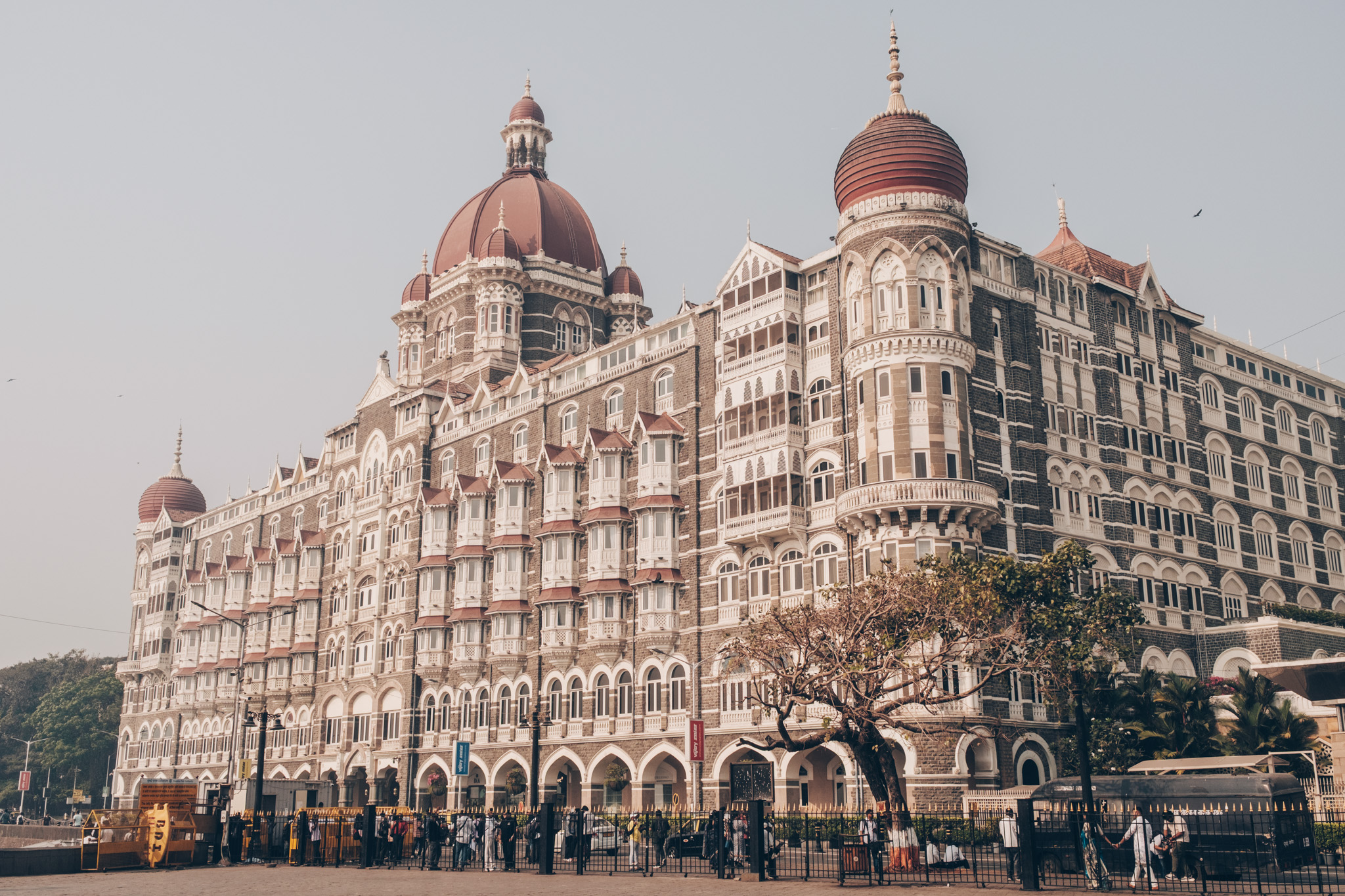

Two ferries depart from the square at the Gateway of India. One to the tourist island of Elephanta, the other south to the town of Mandwa. I see two lines – I join the one with the more Indian faces, the less touristy ones. I hope they're just locals heading to the beaches outside the city. Every now and then, someone approaches me to chat. The classic "where am I from, where am I going, what am I doing, can we take a picture, do I have Instagram, etc." I suspect that if I spent a day there and shared my Instagram account with everyone, I'd get banned for getting a million new Indian followers in 24 hours.
It's worth noting that the queues in India have a lot in common with the movie "The Human Centipede." You stand so close together that you can't get any closer. If I accidentally got pregnant, which is possible given the crowds, I wouldn't even know who I was with. If you leave a seat empty, someone will probably just jump in. Some guys come up to me and tell me it's pointless to wait and that I should follow them. We actually bypass the entire queue, go down to the boarding gate, and... 10 seconds later, we turn around. One of the guys says, "sorry, my friend is an idiot"It turns out you can't just walk past the queue and get in first, shocking. We line up a dozen or so meters further back than we were standing. Luckily, we catch the ferry anyway."


Chapter 3. I'll Get Cancer of Everything
but it will be worth it.
On the ferry, I meet tons of new people. I'm a little freaked out by the fact that everyone's wearing life jackets, but maybe it's the better of two evils. Someone invites me up to the top deck, and as I step up, I hear a shout: "Guuuyyysss! Maciej is in the house!" A festivities of photos, stories, Instagram and WhatsApp exchanges ensue. It's some kind of company weekend trip to the beach. People bring portable barbecues and food. Just when things couldn't get any more cheerful, someone asks me where I work. Every time I tell them I work for the company that makes Durex, the result is the same: endless laughter.
I have to admit, Indians are probably one of the most "homey" people I've ever seen. A combination of ease, good humor, relaxation, and a positive attitude. The exact opposite of the typical Varsovian I pass on my bike to work. One thing's for sure: on most ferries, and I take them every 50 kilometers or so, I'm the only one with shoes and socks.
The 130 kilometers I cover that day could fill an entire post. I pass everything, see everything, and feel like I'm contracting cancer everywhere: lungs, esophagus, brain, and skin. Perhaps not bringing sunscreen wasn't a wise decision. It wasn't until the third day that I stopped at a pharmacy to buy some. I paid 12 złoty, and I have a sneaking suspicion I'll be the only person to buy such a product there this year.
I drive on roads both small and large. With unimaginably heavy and nonexistent traffic. Tuk-tuks, colorful trucks, cars, and scooters pass me by. Sometimes there are hills, sometimes the coast. Sometimes the asphalt is good, sometimes bad, and sometimes none at all. In a few towns, I get a bit lost because I'm riding without navigation—just like that, by azimuth, south, along the coast. There's sometimes a lot of trash, sometimes a moderate amount, but it's almost always just plastic. I pass a girl practicing tightrope walking, boys playing cricket, a group of cyclists, people carrying large bags on their heads, cows roaming the roads, hundreds of dogs—most of them sleeping in the middle of the road, but they don't look particularly hungry or neglected. One barked at me. I have the impression they've adopted the Indian approach to life. There are so many stimuli and sensations that it's impossible to describe. After all, it's about 10 hours on a bike, in a completely different world. Different, yet the same.
I end the day at a series of adjacent beaches. I feel like all of Pune is there – it's the weekend, after all. Pune itself is 170km to the east, about a four-hour drive, so I'm probably in the best place for a weekend beach getaway. I have the impression that around 2 million people are watching the sunset. It doesn't occur to me that this might make finding accommodation difficult. Indeed, the first two resorts are completely full, and only in the third, a few minutes from the sea, do I find a free space. The area is also becoming more Muslim. I'm reminded of this by the "no alcohol" signs everywhere… and the mosques.
I'm staying at Mezbaan Paradise Resort. I ask the receptionist about the price – it's 160 złoty per night. I choose the breakfast-inclusive option, so the price increases to 120 złoty. I don't know, I don't understand, and I don't ask. I highly recommend the accommodation. Clean, tidy, hot water, toilet paper – which isn't obvious in the context of a longer trip, so of course I steal it. The most important thing is that there's a ceiling fan. Ceiling fans are so powerful that when they're turned up to maximum, everything starts flying around the room. This works well for me – I wash my underwear every night and they're dry within an hour. I also use an old Indian trick – I wrap a wet piece of clothing in a dry towel and walk on it for a while. I recommend it – water transfers from the clothes to the towels.
That evening, I order two more dinners at a nearby restaurant, which leaves the staff somewhat baffled. Communication is generally quite difficult, even though we all speak English. The waiter asks a thousand questions and then relays the answers to the chef, who is standing two meters away. I order soup, but I can't get it because there's no tea. He asks if the dinner should be spicy, and I say absolutely not, so I hear him tell the chef it's medium. I still get spicy, but as it turns out, after visiting Hyderabad, nothing is ever very spicy anymore. Then he spends 10 minutes trying to discuss with me whether I want cold or hot water. Another 10 minutes after ordering, he comes to tell me I haven't received my food yet. I make a "thanks, man," face, but I don't think he understands. He asks where I'm from, I say Poland, and asks if he knows where it is. He replies with a smile that he's not from Poland, but from India. I ask for the Wi-Fi password, but he says he doesn't know and disappears over the horizon. For two large Biryanis (rice with chicken) and two liters of Coke, I pay 25 złoty. It's not easy to fall asleep with the muezzin shouting in the background after drinking two liters of Coke. Before falling asleep, I still struggle with the light switches.
From the perspective of the entire trip, this was one of the most interesting days. Not necessarily in terms of the views, but in terms of the variety and the people. Although maybe that's because it was the first day and everything was still new. In the following days, I'd start to notice recurring patterns that would become boring after a week.


Chapter 4. The second day is perfect,
mainly for deviants and masochists.
I spend the morning searching for a hat to wear under my helmet. The fan blew it into some far corner of the room. Then breakfast, a conversation with a new waiter about whether Poland has permafrost and polar bears attacking people, and then it's time to move on. I'm so tanned that a man on a scooter stops me and asks for directions to a city. The most annoying thing, as in many African countries, are the tall, reclining police officers. They slow traffic to a crawl, and they reach about a third of my 16-inch tire. Someone asks me where I'm from, and I say Poland. He says he's been to Israel, so he knows. These are the kinds of conversations and interactions we have here. After each one, I need about 15 minutes to think about what just happened.
The second day is very challenging. I'm really glad I'm riding alone. Minor navigational errors have me diverting several times from the coast onto side roads that take me up the surrounding hills. This means that over 140 kilometers I rack up almost 1,700 meters of ascent, which is a bit uncomfortable on a folding bike, but that's not the main problem. The problem is the unbelievable heat—the kind that makes your eyes water—and the steepness of the hills. So, I have to turn back several times. to boot, which, with no shade, no wind, no shops, no asphalt, and no hope, is pretty hopeless. I'm looking for the positives. If I die and they find my body in a month, it'll be scabbed over, so the insurance company will still identify me and pay out. Then it's even worse; the wind comes and blows at my back. Normally, this would be a plus, but in this case, it creates a situation where I don't feel any air movement.
I often feel very cheated. My uphill riding is dramatically slow, but the descents are also slow. On the side roads, especially on the corners, there's a lot of gravel, which the Brompton doesn't quite cope with. Or maybe it's just me not quite getting the hang of my technique, I'm not sure. I am, however, certain that overshooting this corner would probably be the last overshoot of my life. I have a feeling that the combination of the heat and the lack of shops means that even a severed limb wouldn't be oozing blood. I feel a bit like a salted Lay's chip. And I feel cheated because just when I think I've reached a very high point and am starting the descent, the sea appears before me. Which makes no sense, because how on earth is there a sea on the hill? The elevation profile shows that I only crossed 200 meters above sea level a few times that day. I crossed 250 meters twice, and those were the only two times during the entire trip.
It's very pretty, though; at times, you could almost say I'm driving through fjords. It's also very ugly at times, but that's even better – some variety. If something is ugly, it effectively highlights the beauty of something nice, or sometimes even average. That's why it's always worth having an uglier friend by your side. Once again, I pass an abstract number of things I can't describe here. From a woman with a fish in a bowl on her head to a roadside orchestra.

I won't lie, I reach my hotel in the evening barely alive. Throughout the entire trip, I basically only eat breakfast, dinner, and during the day a mixture of water and Sprite or Coke (or its local equivalent, the delightfully named Thumbs Up!), sometimes honeyed peanuts. I simply don't want to risk a stomach upset... or maybe nothing along the way appeals to me. A 1.5-liter bottle of water and 0.6 liters of Coke costs about 2.5 złoty. Once, someone in a shop wanted a suspiciously large amount, probably because it was near the ferry, but I managed to successfully haggle the price down to the standard price. They probably didn't realize I was already a professional shopper and had already bought this combination 20 times. Only a moment later did I realize the price was 40 groszy higher, and I'd only bargained for 20 groszy. A huge success for the white man. If I had a time machine and went back 11 years to invest those 20 cents in Bitcoin, I could buy a Big Mac at McDonald's today for that amount.
I'm staying at the Nisarg Resort in Guhagar. They convinced me with a photo of the pool with a mural of a dolphin in the background. It's also located on a large beach, but it seems decidedly less touristy. I feel like I'm the only one in the entire resort. And of course, there are a thousand staff members – each responsible for something different. I pay 160 złoty for a night. That's a lot, but my search is also the opposite of usual. I sort the nearby options by price and choose the most expensive ones. There are two criteria: cleanliness and air conditioning that doesn't face the bed. Sometimes I ask for a room change for this reason. Turning off the air conditioning means you'll get boiled overnight. Turning on the air conditioning that faces the bed can cause throat problems.
My reservation is going very well. There are only three people on the other side of the counter, all surprised to see me and all mentioning my Google review in every third sentence. I ask about a room with breakfast. They say they don't offer breakfast, but I can have a room and breakfast. The problem is, breakfast is served a bit late. So I say I want just the room. Confusion, we exchange glances. I look at them, they look at me. No one knows what to do now...
About three hours pass, at least in my head, because to the world around us it probably only takes about 10 seconds. The guy asks for my passport, makes a photocopy so he can take out a loan in my name in the future, asks me to sign the photocopy so he can copy it when he buys a house on my behalf, and begins copying the passport data into one of the many, crucial Indian books documenting reality. From now on, my name is P. P stands for "Mr." in my passport. Then he spends five minutes looking for a visa in my passport, another five minutes searching for my address, which, of course, isn't in our passports. Finally, he has to fill in the registration number of my vehicle, which is a bicycle, in the register. For the sake of the moment, we agree that I arrived by bus. He gives me the key to the room – number 203. All that's left is to arrange dinner. I say I want two portions of chicken with rice, just to make things easy. One for now, one for breakfast. The whole Indian system breaks down when I try to eat dinner for breakfast: because it will be cold, because it's dinner, because whatever. Finally, we agree that in that case, I'll eat two dinners, but that I won't return the empty plates until the morning. I'll go to hell for lying. We agree – I'll get dinner in… two and a half hours. He asks which room I'm staying in – I look at him like he's an idiot and show him the key he gave me. me a moment earlier. He also looks at me like I'm an idiot, it's a draw.
To avoid starving, I head into town to the store. This is one of two supermarkets I'll visit during my entire trip. Although "supermarket" is a bit of an exaggeration, it's simply a store you walk into. Like everyone else, I leave my shoes outside and, as probably the only person in the store's history, I go inside in my socks. I grab two packets of chips, two packets of nut biscuits, three desserts from the fridge, two yogurts, and a chocolate bar. This might not be the best idea, because as I'm standing in front of the fridge, the power goes out. I start to wonder how long yogurts spend in the fridge, whether it's on or off. Looking at the chocolate, also in the fridges, I see it's probably been melted 73 times. I pay 997 rupees; the lady will owe me 3, since I'm giving a thousand in notes. Apparently, being owed a penny has reached even here. Although interestingly, I have encountered shops where instead of a penny in memory, you get a candy in your hand, or if there are several pennies, several candies - a beautiful thing.
In the evening, I discover three very important things. First, the desserts I bought consist mainly of sugar. They're practically inedible – I check the ingredients: sugar 38%. Second, you shouldn't carry a spoonful in the same compartment as an open butt cream. Third, if it's 35°C outside and you're cycling all day, you should drink plenty of water and use electrolytes, which you carry in your backpack. This is a new approach for me, because I usually carry electrolytes with me the entire trip and they come home with me. The same goes for emergency bars. During the night, I'm battling the worst cramps of my life. They're so intense, I start to wonder if something in my leg might burst. It didn't. And of course, at bedtime, I struggle with an endless number of light switches to create darkness. It's been a very difficult day, and this is only the second of seven.


Chapter 5. Thai jungle, American coast, Kenyan savannah.
The second day was everything, but the third was even more so. For the first time, I entered what looked like a true jungle. The pattern was the same: a bit on the coast – then green and somewhat shaded, a bit on the hill, then dry wasteland, and in between these sections a bridge over a river flowing into the sea and the towns along it. This is the section where I encounter two groups of cyclists riding with luggage, something I've never seen before or since. There's a British couple spending their retirement traveling with panniers, but there's also a group of Indians in identical jerseys, riding a multi-day route on creaky bikes. Somewhere along the way, I even see monkeys – thankfully, they're not particularly interested in me.

At times, the route resembles the Pacific Coast Highway—the most epic of epic roads in the world. That is, according to Americans, not me. If I were a famous blogger and India paid me to promote the country, I would do a great piece there. If I were a famous blogger and India didn't pay me, I would do the same, but more about the contrast between trash and beautiful nature. I drive on perfect asphalt, gently winding sideways in gentle curves, but also winding up and down, making the views of the sea more than admirable. I'll write about the trash, the smell, and the general condition of the roads once I've decided which blogger I am.

Sweeping in front of your own house seems to be a serious hobby here. What's worse is that the attitude is – I'll sweep here, but I'll throw my trash 30 meters away. Local cleanup crews, small but existing, rake trash into piles in ditches and then set it on fire. It's undoubtedly a cheap and effective method. When I see these beautiful areas, and at the same time, the level of trash everywhere, I'm reminded of the lyrics of Kazik's song: "What have you motherfuckers done to this land?" How can something so beautiful be so neglected? Although plastic-free zones and posters warning about the negative impact of pollution do appear from time to time. Perhaps it's just a matter of time. This isn't just due to poverty, but also to the mentality that prevailed here some time ago. Even my friends from the tight-knit IT world can roll down their car windows and throw an empty container outside. A much more common sight, however, is opening the door and shooting a huge amount of phlegm onto the asphalt. You can get a serious fine of PLN 20 for littering in a plastic-free zone.
Most of the time, when I look at the beautiful coast and the cow drowned in plastic, only one thought comes to mind:
take another shit in the middle!
Around 130 kilometers, after nearly eight hours of constant pedaling, I start looking for accommodation. This time it's not easy. There are options, but either they're not very well-directed or you have to go off the beaten track and into a remote area. It's not a problem, but with 16-inch tires, I try to be reasonable. The nearest large city with shops and hotels is 40 kilometers away. Less than two hours until dusk, and somewhere in my head I calculate that it might work, but the last bit of my brain rightly tells me it's a very stupid idea. I check if there's an Uber nearby; maybe I could cheat a bit. Unfortunately, there's no internet, but even if there was, it wouldn't help. Uber is only available in the largest cities. I stop at a bus stop and ask the tuk-tuk drivers if they can give me a ride. They unanimously reply that it's too far for a tuk-tuk. This always puzzles me. Why would it be too big a trip? You can even buy gas from a plastic bottle at the convenience store. They say I can wait for the bus, but there's also a bunker here. Not a hotel, but someone's house. I don't like the idea, but if not now, when?

I turn off to a town under a large bridge, straight to Delight Homestay – Jaitapur. The house is a home, with people sitting on the veranda. I ask for a room, someone calls someone, that someone calls someone else, and it turns out it could be ready in 15 minutes. It might not be large or luxurious, but it's also slightly better than the rooms the CIA uses to rescue kidnapped American spies. I'm also greeted by two dogs, their eyes giving clear instructions: "stay, order meat and don't finish it". Some kid also brings me juice that looks like watermelon but tastes like evening diarrhea.
My room is divided by a bed.
Stairs divided by a bed.
On the left side there is a bathroom
On the right… 14 switches.
The room consists of a bed and a ceiling fan, and next to it is a bathroom with a bucket for showering and a Czech-style shower—the kind where you can poop and wash at the same time. The electrical cables are expertly wrapped in duct tape, so I don't die like the tourist who died there before me. I even manage to get a huge dinner and a huge breakfast. Ordering a double dinner means I get two portions of rice and one portion of meat, but that's enough for me. Eating the whole thing is beyond me, as it was served on a terrace by the river, and every thirty minutes I'm bitten by a mosquito. So I have to find the perfect balance between being bitten and being full. I remember checking if there's malaria in India, but I don't remember the results. I boldly assume that since I didn't take DEET, I probably didn't have malaria. I checked now, malaria exists, although it is not very common, you can also get the virus for free Zika and Chikungunya
For breakfast, I got local bread and two omelets, each with about four eggs. I'll be setting off with a particularly full belly. There was also the option of fish, but looking at the river from my room window, I'm almost certain I won't want any of it. The total cost is less than 200 złoty. In the evening, while struggling with the circuit breakers, I realize I've mixed up the return days to Warsaw and won't be returning on Saturday at all, but on Sunday. Considering that this is the end of day three, I've covered 400 kilometers, and with good winds, I should reach Goa, my destination, the next day, I don't know whether to be happy or cry. A normal person would declare victory at the finish line and spend three days in an expensive beachside hotel celebrating victory. I know full well that I'll simply continue south. I don't know where or why. I decide not to dwell on it. Dwelling on it is the worst. The greatest advantage of my vacation is that you simply travel, and you have to focus on surviving.


Chapter 6. If you ride two days in one day, you get one day of riding for free.
I'm a fool. Like that woman in the viral video where she's crying and wondering why she ran a marathon and what she was thinking. I'm advocating this theory because it's only day four of the ride, and I've covered 160 kilometers. To make matters worse, I'm also covering nearly 1,800 vertical meters because the map told me I'd be riding on flat ground. While riding, it doesn't feel like I'm riding on flat ground at all, but I'm an IT guy, I trust data, not gut instinct. A few times, I do walk my bike uphill for extended periods, even on good roads, but maybe I'm just weak.
The day is no different from the previous ones, and a slight sense of weariness sets in. Perhaps the highlight is the fact that there are signs about animals along the way, the more interesting of which are panthers and mouse deer. It's not bad, though; in Goa, you can also spot a Bengal tiger, for example. Generally, the further south I go, the greener it gets, and the large tourist resorts start to appear more and more frequently.

The pattern, however, is always the same: coast, drive up a nearby hill, desert and drought, descent, bridge over a river to the sea, jungle, coast with a city, drive up a hill... and so on. Every few bridges, stop at a stand for a Coke and water. Even the temples are starting to look the same. They're colorful, with interesting carvings, but definitely less impressive than those in CambodiaI'm slowly stopping taking photos, which is a sign that the driving experience has diminished somewhat.
Perhaps the long distance is due to the fact that my internet connection went out at the end of the day, making finding accommodations a bit difficult. But perhaps it's also because, just across the border from Goa, I find Fort Tiracol Goa, which feels like a vacation. It's a monastery perched on a high cliff, right by the sea. It has a church, a restaurant, and plenty of luxury. Just what I need that day. Breakfast included costs 300 złoty for a huge room, with a huge bed and a terrace worthy of a movie about rich people.
As befits a proper, luxurious hotel, my bike isn't allowed in. The security guard tells me to leave it in the parking lot. Of course, I disagree, but 15 minutes of discussion doesn't solve the problem. Eventually, we put it in the security guard's booth. Why I didn't fold it and put it in the IKEA bag I carry with me all the time—I don't know, but thinking while checking in bikepacking is not my strong suit. Fortunately, I am at peace with that.

For dinner, I have a pizza, or rather three. I eat them in my room because there are so many midges and mosquitoes outside that I can't stand them anymore – they're not cheap, around 30 złoty each, but I'm in a state where you can pay practically any amount for a good pizza. Besides, I feel cheated because the prices on the menu were net. Unless they weren't, and the guy bringing the food to my room is simply cheating. Fortunately, I have no reason to suspect him of that. The waiter explains that the midges are because it will rain overnight, or it won't. I check the weather forecast – the total predicted rainfall over the next 10 days: 0 millimeters.
It's so luxurious that I even decide to shave. Most hotels have a shaving kit and a double-brush kit. Is that a good idea? Of course not, especially since I stumble upon it in the morning instead of the evening. I remember this an hour later when I put on my helmet, its straps stiff with sweat. For the next two hours, I feel mostly stinging and white dots growing on my face. Well, if I were looking for a wife here, my appearance probably wouldn't be the main attraction anyway, so besides the physical discomfort, it doesn't really matter. Especially since I'm not looking for one – I think I already have a few in various African countries. And the stinging on my face keeps me from thinking about the pain in my legs. I'm not sure what condition they're in; the stinging drowns out everything else.
Chapter 7. Goa is not cool.
I start my day with a free ferry. I take at least two every day, though this is the first time I don't have to pay. Normally, even a bicycle requires its own ticket, though we're talking about costs in the tens of cents. Now I'm fully in Goa, the one mainstream destination in India where tourists go. As you can see from the offer for holidays in India and the photo of the beach – it's Goa on 98%. And it shows.

Of all the places I've seen in India, Goa is my least favorite. It's the greenest, and eventually the terrain gets a little rough. flattens – Over 155 kilometers, I climb about 1,100 meters, but it's also definitely the most touristy. Loads of white tourists on scooters, tons of alcohol shops, tons of attractions of all kinds. Like the Polish seaside in summer, only in India – an unbeatable combination. The buildings, however, are truly impressive. Like Otwock, or another Józefów, but in a British-colonial version, you can see that the region is definitely richer and cleaner. Somewhere along the way, I hit a huge, four-lane bridge and roads that would be like highways here, but it's not a problem. Traffic is slow, and on the main roads, almost nonexistent. Most of the time, I drive like through a jungle – that's how I imagine Cuba, for example. I still can't communicate with anyone, even though we all speak English. I stop at a stall to get my water and Coke combo. The guy tells me he doesn't have any water. I show him that it's right there, on the open road. He tells me it's 20 rupees and that I prefer it from the fridge. I buy it and still don't know what he's talking about.

It's tough at times. In a moment of despair, I sit down at a bus stop and eat my honey-coated peanuts, drinking a Coke. Something bites my leg, and after a moment, it's all numb, and I can hardly move it. I have two options: I can go and hope that whatever's flowing in my leg will somehow spread through my body and dissolve. The other is that I can go, and it will spread through my body and kill me. I choose the first option. To make matters worse, a bird pooped on me when I stood under a tree for a moment. I have the impression that the local side roads were built by Czechs from the Karkonosze Mountains. I also have the feeling that with a bit of luck, even a tuk-tuk might overturn here. Vacation.

Around the 130th kilometer, just after 20 minutes I booted With my bike, because someone decided to unleash the sun and let me take the road uphill without any bends or concerns about the gradient, I'm taking the very main road. I suspect it's even the most main road in the wider area. It has the beautiful number "66" and is basically the only road running along the coast for the next thousand kilometers. Even the road markers along the road measure the distance to the town, which is exactly that distance away. This pains me a bit, because for the next few days I'll either be riding this road or taking the tiny roads leading through the surrounding hills. I have a feeling the weather and the condition of my legs won't allow me to enjoy this choice. So I risk it and head south on a two-lane road with a large shoulder, to see what happens and what happens.
It turns out it's very good. The road may be large and main, but there's very little traffic. In fact, if it weren't for the occasional wrong-way vehicle, I'd say it's perfect. It might be a bit boring, but it still cuts through towns, and since I'm going much faster, everything moves much faster. For fun, I occasionally enter a town or a smaller road. I don't know why.
My plan is to get to Udupi and catch a train back to Mumbai – I'm a few dozen kilometers away. I'm about 40 years old, and such thoughts still make me laugh. I can even imagine the title of a blog post: Mumbai Udupi – An Indian Adventure. Around the 150th kilometer, as I'm checking out the map, some guy rides up to me on a bike. Normally, people ask me where I'm from, where I'm going, and what's up. In larger cities, the conversation often starts with "how much does that bike cost?" This time, however, I spend about 20 minutes with the guy. We show each other our Instagrams, talk about cameras, because it turns out he's also a bike enthusiast. Then we talk about bikes, then about working in IT, and somehow the time passes, and the sun is setting, making me a little nervous. I don't know why, but I'm afraid of riding in the dark. The guy explains to me that it's pointless to end the route in Udupi, because then there's another large town – Mangalore, and in between is probably the most beautiful section of the road I'm driving on. The one along the sea and beaches. He explains that Mangalore might be about 300 km away, but not only is it worth it, but the road is flat and straight. He shows me online search results for "best beach roads in Udupi" – it really looks impressive. It's a road like our Hel Peninsula, except the land is about 15 meters wide. Beaches on one side, a row of houses on the other, and a river about 250 meters wide.
My brain can't seem to find a counterargument – it doesn't occur to me that I've been driving along this seaside road for several days now. The photos he shows me convince me, and I decide to go there. Especially since there's an airport in Mangalore, and I'll be back in Mumbai in just one hour instead of a dozen. I'll miss the Indian train adventure, but maybe that's a plus.

Taking advantage of the fact that my average speed on the main road exceeds 25 km/h for the first time in months, I reach a larger town with a wide selection of hotels: Karwar. I sort the accommodations by price, choosing the most expensive and with a high rating: the West End Hotel. I think I pay less than 100 złoty with breakfast, but I skip it. The official story is that I'm up early and in a hurry, though I don't know where or why, and breakfast isn't available until 8:00. The unofficial story is that there's a pizzeria in the same building, where I order three pizzas for 12 złoty each, and I also visit the local grocery store. So, I have the pizza from dinner for breakfast.

It turns out that that day, covering nearly 160 kilometers, I drove across the entire length of Goa—from north to south. I probably passed dozens of beaches, but the road was laid out like in Poland—I couldn't see any of them because I was separated from them by houses.


Chapter 8. Not everything that doesn't make sense is pointless
Jitna door jaoge, utna khud ke kareeb aaoge.
The further you go, the closer you will become to yourself.
A normal person would say that my planned route for that day is pointless. Well, they'd probably say that about the entire route, but especially about that day. If I had a plan, which I don't. It's about 300 kilometers to the airport, and I still have at least two days to cover it. So I'm doing 185 kilometers on the flat, which translates to a thousand kilometers vertically – they're on the main national road. It sounds silly, but I really like including stages like that in my trip. Driving on a long and boring road, contrary to appearances, also allows me to see something new. Especially since I try to detour a few times – it usually turns out to be pointless, but sometimes I stumble upon a surprise. Apsarekonda Sea View Park wasn't one of those – getting there required a 20% uphill climb in the heat just to make a loop that happened to bypass the waterfall (which isn't there at this time of year), the viewpoint, and the animals, which were underwater so I couldn't see them.

Murdeshwar, on the other hand, was a pleasant surprise, with a very pleasant asphalt road leading to it, right along the beach—a very large beach, by the way. Then the asphalt road turned into a dramatically poor surface, but it was still worth it, because on the headland appeared a huge statue and a whole host of colorful and shiny things. I somewhat regret not peeking inside, but judging by the crowds, it could have been a real challenge. Only now, searching online, do I realize that was a big mistake: the Bhukailasa Cave Museum, the Statue of Lord Krishna & Arjuna, and the Shri Shanishwara Temple are places with statues that are probably impossible to forget. The nativity scenes are hidden in the background. Our figures have too few arms, too few heads, too few cows, and generally too little of everything.
On one of the side roads, the ones branching off the main road, a guy on a scooter pulls up next to me and asks why I'm here. It's a very difficult question, one that many philosophers have asked themselves over the years, but I assume he's referring to this particular road, or maybe even this particular intersection. I tell him where I'm coming from and where I'm going (I'm making things up, because I don't really know where), but I can tell something's not quite right in his head. He's trying to understand, first, why I'm cycling when I could have something faster, and then why I pulled onto a side street instead of taking the main road. Difficult questions; I think the easiest thing to do is say I'm lost and ask for directions—everyone will be happy.
Somewhere along the way, I even stumble upon a small "handmade craft" workshop—exactly what I look for on every trip. A family that makes animal figures from local materials. So I knock on someone's door, see a sign like this, someone invites me in, introduces me to the whole family, offers me food, and there's a bit of consternation. Only after a while do I burst in to say I'm here for a shop, not to visit some random Indian family. They take me to their workshop, where I buy a straw elephant, and my vacation is complete.
This is the first time I've seen a collision, or rather a more serious one. rubThe potential is mainly in two places – at the turnoff on a multi-lane road and at a narrowing. Near towns, there are often crossbars that narrow the road to a single lane, and you have to negotiate somehow. Sometimes at schools, there's an extra person who adds a barricade to block more lanes when kids run out. It's amazing that all this chaotic traffic somehow works. I've noticed two rules here: first, you have to ride, and second, you have to look straight ahead, maintaining your attention at all times. I mean, as a cyclist, I also try to look back, but I feel like I could survive without it anyway. And maybe I'd be less stressed. Everyone here rides together, yet separately. Everyone has their own rules in mind, but they all come together to form a larger whole. Compared to the traffic I'm used to, there's much less to assume, and more to improvise.
Along the way, I see a surprising number of billboards advertising… children. Both individual and group versions. Usually, they show a head, the name of the school, and a percentage score – probably from some exam. Often, even down to a thousand decimal places. At first, it makes me laugh, but then I realize it's a brilliant idea. Imagine, for example, a billboard at the entrance to Warsaw with my head on it and a huge caption: "Maciej Hop, FTP 350 watts, better than 99.725% of the population of Warsaw." I buy it, let's do it.
I'm staying at a luxury hotel in Kundapura – Uva Manish. As usual, everything is incredibly difficult, because there may be eight staff members per guest, but each has a very narrow set of responsibilities. For example, I can't order room service from the hotel restaurant. I can't do it at the front desk, nor can I order it from the guy who carries my luggage. He does it very well, by the way – he puts my bike on a cart, and at every turn, the bike falls off the cart with a bang. I have to ask the front desk to call me back in 10 minutes and order room service there, only to have the same guy with the cart bring it to me an hour later.
In the evening, I go to the store. There's nothing there, of course, but it takes four people to buy chips. Me, the person who dictates what I've bought, the person who fills the register, and the person I pay. Interestingly, there's no person carrying my shopping cart, but there is a woman who constantly follows me around and makes me nervous. I also discover why, in the few places where I could pay by card, my payments were rejected – the PIN pads here have a different layout of numbers, so entering the layout from memory requires a different number. In any case, everywhere, payment is usually made in cash or the local payment system, based on QR codes, which I haven't mastered.


Chapter 9. I don't feel like it.
And if I told you there's a pope in Mangalore, would you believe me? And what if I told you there are two popes standing next to each other? And what if I told you it was just a coincidence that I was there and decided to visit them? Or that right next door is a grocery store called "St. John Paul II General Store," which in our language would translate to "Pope's Grocery Store"? And what if I added that buses parked next to the store with a large sign reading "Holy Family" on the front?


So of course I'd go a bit of a detour to see it. Especially since "Pope John Paul 2 Stage site"It's only 7km from the airport, where I should end my day, as my flight departs at 9am the next morning. I'll admit, however, that I'm not having a particularly good time during the 120km I covered that day. Yes, the road along the Udupi beaches is indeed pleasant and pretty, but the rest of the day is exceptionally tedious, and the closer I get to Mangalore, the more traffic on the main road increases. Because of the many buildings, serious traffic jams form at the hairpin turns and narrowings. However, the villages by the sea are becoming even richer, cleaner, and more pleasant. For a moment, I consider that they might be a pleasant place to live – people even have well-kept gardens. Somewhere along the way, I pass a fish market, and as crushed ice sprays everywhere, for the next week I'll smell not only of smog, dust, and sweat, but also of fish.
On the outskirts of Mangalore, my brain is no longer working. I avoid the city, try to avoid traffic, and end up in some Total Energies industrial estate. Then a series of inexplicable decisions follows. I avoid the hotels right by the airport and go into the city center anyway. Maybe because they all seem too cheap, maybe because I don't see any decent food nearby. I end up at THE OCEAN PEARL INN – I don't remember how much it cost, but since it was one of the more expensive and highly rated, it was probably around 200 złoty. Everything about it is great, it even has two restaurants inside. Generally, in most places, restaurants come in pairs – one vegetarian, the other classic. I accidentally end up at the vegetarian one, but then I go to the convenience store and the local bakery, so my calorie intake is still positive. Unfortunately, the hotel is too far away for me to cycle to the airport in the morning with a smile. So I calmly pack my gear into two IKEA bags and set off in the morning, around 6:30 a.m. In the evening, of course, I asked if the front desk could call me a taxi. They can't, even though they have their own transportation company; at most, they can give me a business card with a phone number. But when I asked about Uber, they said it wouldn't be a problem.
The problem is, Uber may be working, but no one wants to take my ride. And when someone does, they call or text me something I don't fully understand. It turns out the price from the city to the airport is fixed and has nothing to do with Uber's proposed price. So even my manual tips don't help. Ultimately, I wait about 25 minutes for the ride, and I'm very glad I left the hotel early. However, I'm surprised by the taxi driver's attitude. The price in Uber is 400, we agree on 700, I hand him 400 because I don't have any change... and the guy somehow refunded me 100 in the app later. These numbers were probably completely different, but I'm trying to illustrate the taxi driver's honesty, which is an unusual situation. I fly an hour to Mumbai, drive there for two or three hours, waiting until 2:00 PM to check into my hotel, and stare at the ceiling until the next morning. End of the trip, I survived, great success… or so I thought.
Chapter 10. Whenever someone somewhere in the world does something stupid
Maciek loses out on this.
In the afternoon, I sit relaxed and alternate between staring at the ceiling and the sea. I've picked up my suitcase from the Novotel, packed my things, and I've found a cheaper place to stay, but it's only 100 meters away. I can immediately walk to the beach, along with half of Mumbai, to escape the ball being hit by hundreds of cricket bats. While scrolling, a message pops up on my phone that Emirates has canceled all flights via Dubai. I check the app—everything is green and confirmed. I check Instagram—the rockets are flying, so the planes are at a standstill. I head to the airport because I'm not going to call Emirates on my phone.
I'm not allowed into the airport because, when I scan my ticket, it turns out that the flight is actually canceled. Like most others. This is a problem because I have no way to ask anyone anything – all the airline desks are inside the building. It's even worse because there are tons of people like me, and the internet masts must be giving up, because Skyscanner won't load. It's a Saturday afternoon.


There's a theory that a fool is always lucky, but I think people simply judge overly calm people as "stupid." I take a taxi back to the hotel and use the flight search engine. I find a direct Air Arabia flight to Frankfurt and then a LOT to Warsaw, also for Sunday. I click buy, but I see there's only one seat left – I can't pay in time. Good thing that flight didn't leave. So I bought it for the next day. I don't know if it will depart until the very last hours. I do know, however, that it was probably one of the most expensive flights per kilometer I've ever seen. Or so I thought, but it later turned out we were flying in a serious circle, over Egypt, arriving about three minutes later than we should have. Around, because the Air India I chose isn't allowed to fly over Pakistan. It probably has something to do with the one I mentioned earlier: "we bomb them".
He's changing to a more expensive hotel, one with breakfast and dinner included, so I can stare at the ceiling for two days. I'm trying, because when I enter the Sun-n-Sand Mumbai Juhu Beach, I'm told you can't just walk in and book a room. So I do it through Booking.com and wait 20 minutes for the receptionist to get a confirmation – my phone confirmation isn't enough. We're still trying to figure out what the "half board" option is, but neither of us knows – we boldly assume it's simply dinner included. Two nights is a little over 1500 PLN.

I unexpectedly have the whole Sunday free, but I don't feel like unpacking my bike anymore. So I go for a walk along the beach until it's over. Then I take a taxi to the main station. There, I meet a bored guy who takes me on a tour of the city. We take taxis, trains, visit temples, important landmarks, and so on. It takes me over 20 kilometers. The guy invites me to meet his friends and family, but I'm not particularly keen on it. He even buys me tickets, despite my objections. On the train or subway—I'm still not sure what we're taking—there are carriages dedicated to women and a separate one for people with cancer. Not so much the entire carriage, but half of it—separated by a metal grille. I secretly hope it's just to make it more comfortable for the sick. Some carriages also have a separate first class section—also separated by pipes. This is for comfort, but also to be visible. There's no such thing as a door, just like on buses. This allows you to get on and off even while the vehicle is already moving.
I also get a quick overview of "what's currently trending on Indian Instagram." So I meet a guy pretending to be Michael Jackson, the history of the Holi Festival, which will take place in two days, the most famous music hits, and a report on Mr. Messi's visit to India, who even received his own sculpture for it. Fortunately, he still has fewer of those than the Polish Pope. My guide also shows me the TV series he's starred in, as he used to be an extra by profession. For example, he played a nurse in a movie about a hospital; I feel like I'm talking to Joey from "Friends," because the scenes I'm shown look like they're from "Days of Our Lives." The conversation, of course, also turns to my personal life. As usual, as I explain that instead of a wife, I have a concubine and instead of children, a dog, I sense a complete lack of understanding on the other end.
I keep wondering when he'll ask for money from me. Several hours pass this way. We visit, for example, a temple with a beautiful name: Babu Amichand Panalal Adishwarji Shwetambar Jain – I would never have entered it alone, I probably wouldn't have even noticed it. We also visit what's supposedly the world's largest laundry: Dhobi Ghat. It's a huge market focused solely on washing clothes – the fact that behind this classic market are enormous skyscrapers adds to the effect, so the clash of two worlds is very striking. Increasingly, however, I think these aren't two different worlds at all, and for every high-life, there's also a low-life hidden away somewhere in the corner. Ours is probably in Bangladesh.
In Dhobi Ghat, public facilities supposedly do laundry, but there's also a whole section dedicated to washing jeans, for example. We also visit a park and a large local market, which I'm not particularly fond of. I'm not a fan of places where they keep small dogs in cages and hit them with sticks as people walk by to stimulate them. Although I'm pleasantly surprised by the treatment of dogs in India and their general well-being (of the dogs, not India).

The guy says, as he's saying goodbye, that he needs an investor to invest 8,000 rupees in his food truck. Of course, I refuse, because it's over 300 złoty, and I don't understand the concept of investing in something that will never bring me any return. I tell him I can give him 100 złoty for the tour. He says no; the tour was social and we're buddies, but now I want to spend my money on investing. I give him 100 złoty, and we go our separate ways, offended. I'm a bit disappointed, but also very satisfied. Finally, someone in India has ripped me off or conned me into something. At the last possible moment. After the walk, I take a taxi back to the hotel, eat a dinner that will bankrupt the entire hotel chain, and stare at the ceiling or my own eyelids until morning. Occasionally, of course, checking to see if my flight has been canceled.
I wake up with a cold. That is, with a sore throat, some sort of stuffiness in my lungs, and a strange runny nose. I feel like someone's poured sand into my lungs, and with every cough, gases escape, like from a tuk-tuk. I'm not sure if it's the whole day in Mumbai or the air conditioning. Only in the morning do I discover that the air conditioning, set to automatic mode, maintaining 23 degrees Celsius, is automatically switching between off and full blast. But that doesn't matter, it doesn't matter. I've been refreshing my flight status all morning, and everything points to it happening. I only believe it once I'm on the plane. It worked. As I write this, a week and a half after arriving home, my lungs still aren't fully functional. My heart rate is about 20 beats higher than before the vacation.


I return home just as the winter thaws begin. It's impossible to set foot without stepping in dog shit. This doesn't put me in a good position to judge cleanliness in India...
Chapter 11. I've written a lot, but I still don't know.
It seems to me that for years now, I've been ending almost every post the same way: I don't recommend it, I liked it. I don't know why anyone would do this route. There are certainly many more beautiful, interesting, friendlier, and simpler places in the world. Although I don't know if it was safer, because I felt very comfortable throughout the trip (apart from the physical exhaustion, but that's a bit of a quirk of mine). What I do know is that my perception of India and Indians has changed significantly. And the sudden shift in perception of one-fifth of the world's humanity is quite a profound experience. And more importantly, from now on, with 20% of the world's humanity, I'll have a central topic for small talk. Nothing opens a conversation like saying, "Hey, I recently cycled 1,000 km here..." Regardless of whether you're talking to an Indian, a Pole, or a Kenyan.

